Chinese Takeout Egg Foo Young Recipe
If you've ever looked up how to make egg foo young at home, you've probably noticed the advice is all over the place. Blanch the vegetables or leave them raw? Does seasoning make the patties fall apart? Does cornstarch actually help the texture? I ran three separate tests to find out what actually produces the lightest, crispiest egg foo young patties, and the results were pretty clear.
Egg foo young is one of those old-school Chinese takeout dishes that's slowly disappearing from restaurant menus. When you can find it, the gravy usually ruins the whole thing. It's either watery and bland, or thick and pasty from undercooked flour. This recipe fixes both of those problems, and it includes two gravy options: a quick, modern cornstarch-based sauce, and the traditional roux-based version you almost never see anymore.
This post contains affiliate links, which means I may earn a small commission if you make a purchase. It doesn't cost you anything extra. Full disclosure.
Why This Egg Foo Young Recipe Works
- Raw vegetables, not blanched. I tested both side by side. Blanched vegetable patties came out denser and flatter because the residual moisture keeps the eggs from puffing up during frying. Raw vegetables produce patties that are lighter, puffier, and have a delicate crispness the blanched version just doesn't have.
- Cornstarch in the egg batter. Patties made with cornstarch were lighter and puffier, and they held their crispness much longer when covered in gravy. Without it, the patties were denser and started getting soggy almost immediately.
- Season the vegetables first, then fry immediately. There's a common claim that adding seasoning to the patties makes them soggy and fall apart. I tested this too. If you fry immediately after mixing, there's zero difference in texture and the patties actually taste seasoned instead of bland. The problem only shows up if you let the seasoned mixture sit for 30 minutes or more.
- Two gravy options. The modern cornstarch gravy takes about 5 minutes. The old-school roux-based gravy takes a little longer but produces a richer, more complex sauce with garlic and scallion-infused oil. Both are included so you can pick whichever suits your mood.
- Gentle folding, not whisking. Whisking the eggs until they're smooth and uniform produces patties that are flat and dense. Gently folding the eggs into the vegetable mixture keeps pockets of white and yolk that puff up at different rates during frying, which is what gives you that light, airy texture.
Ingredients You'll Need
Bean sprouts. Use mung bean sprouts and give them a rough chop before mixing them into the batter. Chopping them helps the patties hold a uniform round shape instead of having little pieces sticking out the sides. If you can't find bean sprouts or don't like them, shredded cabbage works well as a substitute.
Cornstarch. This does two different things in this recipe. In the egg batter, it helps the patties puff up and stay crispy. In the quick gravy, it thickens the sauce. If you're making the old-school roux-based gravy instead, you only need the cornstarch for the patties.
Chicken bouillon powder. This goes into the dry seasoning mix that coats the vegetables before the eggs go in. It adds a savory depth that salt alone won't give you. Lee Kum Kee chicken bouillon powder is what I use.
Oyster sauce. Both gravies get most of their flavor from oyster sauce. It's what separates a good egg foo young gravy from the watery, flavorless versions you get at most restaurants. If you're allergic to shellfish, vegetarian oyster sauce is widely available at most Asian grocery stores.
Dark soy sauce. A small amount goes into the gravy for color. Dark soy sauce is thicker, less salty, and much darker than regular light soy sauce. It's mainly used to give dishes that deep brown color you see in Chinese takeout.
Shaoxing wine. Only used in the old-school roux-based gravy. It adds a layer of flavor the quick version doesn't have. If you can't find Shaoxing wine, dry sherry is a reasonable substitute.
All-purpose flour. Only needed if you're making the roux-based gravy. The key with the flour is cooking the rawness out of it before you add any liquid. If you skip this step or rush it, you end up with that thick, pasty gravy that tastes like raw flour. You're looking for a blonde or light brown roux that faintly smells like baked bread.
How to Make Egg Foo Young
This recipe has three components: the egg patties, the quick gravy, and the old-school gravy. You only need one of the gravies, but I've included both so you can try each and decide which you prefer.
Make the Quick Gravy
Add cornstarch, sugar, salt, white pepper, MSG, and chicken broth to a small pot and whisk until the cornstarch is completely dissolved. Then add light soy sauce, dark soy sauce, and oyster sauce.
Set the pot over medium heat and keep whisking until everything is combined. When the sauce comes up to a simmer, let it thicken for a minute or two until it reaches your preferred consistency, then kill the heat. Whisk in sesame oil at the very end. Sesame oil is a finishing oil here, so adding it off-heat keeps the aroma intact.
Make the Old-School Roux-Based Gravy
Combine chicken broth, oyster sauce, light soy sauce, dark soy sauce, Shaoxing wine, salt, sugar, white pepper, and MSG in a small bowl. Whisk until everything is incorporated and set it aside.
In a small pot over medium heat, add neutral oil, green onion whites, and a smashed garlic clove. Saute the aromatics until they're well-browned to infuse the oil with flavor, then remove the scallions and garlic from the pot.
Lower the heat to medium-low and add the flour. Whisk the flour into the oil to form a roux and keep whisking so it doesn't burn. You need to cook the rawness out of the flour, and this is the step most people rush. Not cooking the flour long enough is the main reason you see pasty, flour-tasting gravies. You can tell when the roux is ready either by smell (it should faintly smell of baked bread) or by color (a blonde or light brown shade).
Once the roux is ready, slowly pour in the chicken broth mixture bit by bit while whisking. It will clump up at the beginning, but keep adding the liquid slowly and it will smooth out by the time you've added everything.
Bring the gravy up to a light simmer and let it cook for several minutes until it thickens enough to coat the back of a spoon. Strain through a mesh strainer to catch any remaining flour clumps, then whisk in sesame oil.
Make the Egg Patties
Heat neutral oil in a large pot to 350°F. While the oil heats, mix cornstarch, salt, chicken bouillon powder, sugar, and white pepper together in a small bowl.
In a separate bowl, combine roughly chopped bean sprouts, thinly sliced onion, and green onion whites. Add the dry seasoning mixture to the vegetables and toss until they're evenly coated. Coating the vegetables with the dry seasoning first, before the eggs go in, prevents the spices from clumping together.
Add three eggs, light soy sauce, and sesame oil to the vegetable mixture. Gently fold everything together until the eggs and vegetables are combined. Do not whisk the eggs until they're smooth and uniform. Just fold them in gently. This keeps the patties light instead of dense.
Using a hoak (a Chinese wok ladle) or a large deep ladle, scoop about half a cup of the mixture and place your utensil against one side of the pot. Slowly raise the ladle away from you, letting the egg gently slide into the oil. This keeps the patties uniform and prevents them from scattering across the pot. Repeat with the remaining mixture. You should have enough for 3 large patties.
Fry the patties for about 3 to 5 minutes on the first side while basting the tops with hot oil using a spoon or small ladle. Basting helps the top of the patties set so they hold together when you flip them.
Flip the patties and cook for another 3 to 5 minutes, or until they're golden brown and cooked through. When you take them out, place them smooth-side up on a wire rack or paper towel-lined plate. The smooth domed side has fewer crevices, so placing it face-up lets the oil drain from the craggy underside instead of absorbing into them.
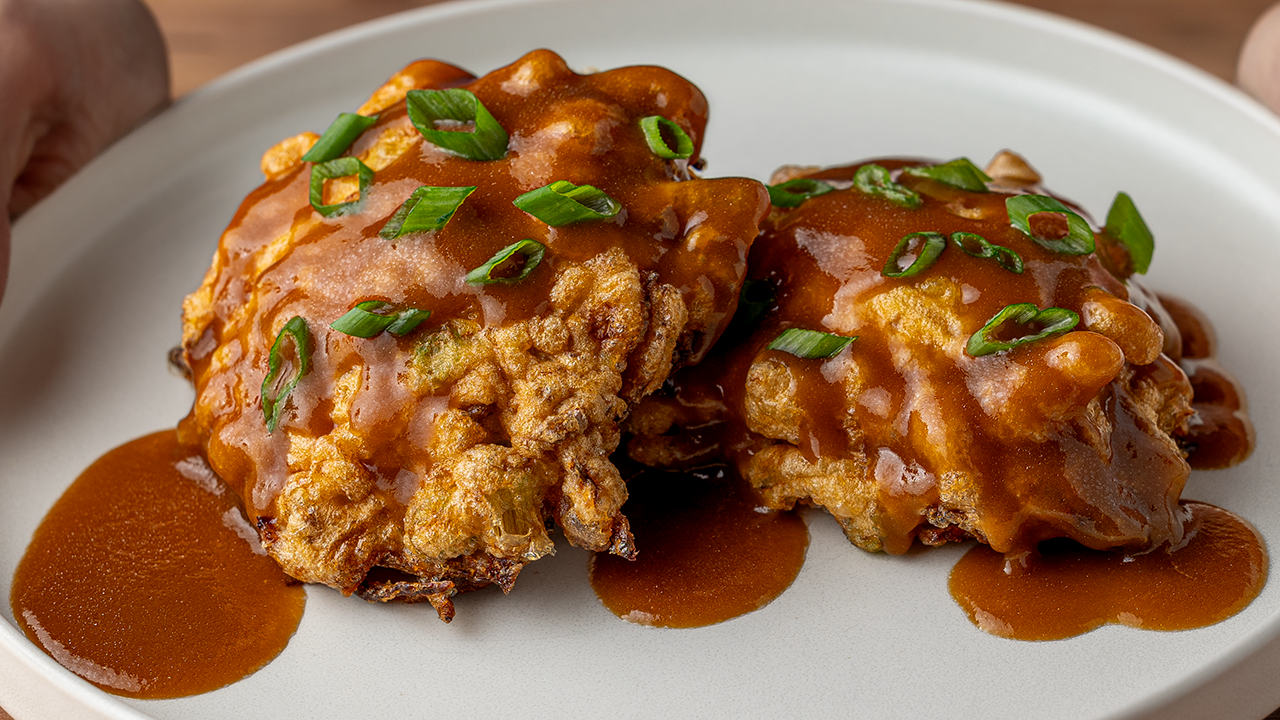
To serve, place the patties on a plate, pour the gravy over them, and garnish with thinly sliced green onions.
Tips for the Best Egg Foo Young
Fold the eggs in gently. This is one of the most important steps in the whole recipe. If you whisk the eggs until they're smooth and uniform, the patties come out flat and dense. Gently folding keeps pockets of egg white and yolk that puff up at different rates during frying, and that's what gives you the light, airy texture you're looking for.
Fry immediately after mixing. The salt in the seasoning will start pulling water out of the vegetables over time, which makes the batter runny and the patties harder to hold together. Mix the eggs in right before you're ready to fry and you won't have any issues.
Use a hoak or deep ladle for the right shape. The domed shape of a hoak naturally forms the patty into that classic rounded shape you see at takeout restaurants. If you don't have a hoak, any large deep ladle works. You can find hoaks at most Asian grocery stores for just a few dollars.
Watch your oil temperature. Start at 350°F. The temperature will drop when you add the patties, which is fine. You want it hot enough to cook all the way through without burning the outside. If the outside is browning too quickly while the inside is still raw, your oil is too hot.
Drain smooth-side up. The domed side of the patty is smoother with fewer places for oil to collect. The underside is craggier. Draining with the smooth side up lets the oil escape from all those nooks on the bottom instead of absorbing into them.
The oil will foam. That's normal. Water from the eggs and vegetables causes the oil to foam during frying. It's not a sign that something's wrong, but leave some extra room in the pot so it doesn't bubble over the sides.
Storage and Reheating
Store leftover egg patties and gravy separately in airtight containers. They'll keep in the fridge for 3 to 4 days. The patties will lose their crispness in the fridge, but you can bring most of it back when you reheat.
For reheating, an air fryer at 350°F for about 4 to 5 minutes works best. It re-crisps the outside without drying out the inside. You can also reheat in a 375°F oven for about 8 to 10 minutes on a wire rack set over a baking sheet. Warm the gravy separately in a small pot on the stove.
And if you end up with leftover patties, look up the St. Paul sandwich. It's a regional specialty from St. Louis: white bread, mayonnaise, diced onion, dill pickles, lettuce, and an egg foo young patty. It sounds bizarre, but it's quite delicious.
Frequently Asked Questions
Can I use cabbage instead of bean sprouts?
Yes. Shredded cabbage is a common substitution, and some restaurants use it as the default. The texture will be slightly different since cabbage holds more structure than bean sprouts, but the patties will still turn out well. You can also mix cabbage and bean sprouts together, or really use whatever combination of vegetables you have on hand. Think of this recipe more as a technique than a set ingredient list.
Why does my oil foam up when frying?
The foaming comes from water in the eggs and vegetables hitting the hot oil. It's completely normal for egg foo young and isn't a sign that anything went wrong. If you want to reduce the foaming, make sure your bean sprouts are as dry as possible before mixing them in. Just leave some headroom in your pot so it doesn't bubble over the sides.
Can I pan-fry instead of deep-fry?
You can, but the results will be different. Deep-frying is what gives the patties that puffy, crispy exterior that defines takeout-style egg foo young. Pan-frying produces something closer to a flat omelet. If you want to skip the deep-frying, some people have had good results starting the patties on the stove in a small cast iron pan and finishing them in an air fryer.
Why are my patties flat and dense?
Usually one of three things: you whisked the eggs too aggressively instead of folding them gently, you blanched the vegetables (which adds moisture and weighs the patties down), or you let the mixture sit too long before frying. The combination of gentle folding, raw vegetables, and frying immediately after mixing produces the lightest, puffiest patties.
More Chinese Takeout Recipes
- Chinese Takeout Crab Rangoon
- Chinese Takeout Egg Rolls
- Chinese Takeout Orange Chicken
- Chinese Takeout Kung Pao Chicken
- Chinese Takeout General Tso's Chicken
- Chinese Takeout Wonton Soup
- Chinese Takeout Hot and Sour Soup
- Chinese Takeout Egg Drop Soup
- Chinese Takeout Chow Mein
- Chinese Takeout Lo Mein
- Chinese Takeout Fried Rice
More P.F. Chang's Recipes
- P.F. Chang's Mongolian Beef
- P.F. Chang's Lettuce Wraps
- P.F. Chang's Beef with Broccoli
- P.F. Chang's Dynamite Shrimp
- P.F. Chang's Singapore Street Noodles
- P.F. Chang's Stir-Fried Eggplant
- P.F. Chang's Fried Rice
- P.F. Chang's Kung Pao Chicken
- P.F. Chang's Spicy Chicken
- P.F. Chang's Crispy Honey Chicken
More Panda Express Recipes
More Din Tai Fung Recipes
Recipe
Chinese Takeout Egg Foo Young
Equipment
- 1 Wok Ladle Hoak style, for shaping patties
- 1 All-Clad Saucepan For gravy
- 1 Whisk
- 1 Ladle For basting patties
Ingredients
Egg Patties
- 1 tablespoon cornstarch
- ½ teaspoon table salt
- 1 teaspoon chicken bouillon powder
- ½ teaspoon sugar
- ⅛ teaspoon white pepper
- ¾ cup bean sprouts rough chopped
- ¼ cup onion thinly sliced
- 2 tablespoon green onion whites
- 3 large eggs
- 1 teaspoon soy sauce
- ¼ teaspoon sesame oil
- vegetable oil for frying
Quick Takeout-Style Gravy
- 1 tablespoon cornstarch
- 2 teaspoon sugar
- ½ teaspoon table salt
- ⅛ teaspoon white pepper
- ⅛ teaspoon MSG
- 1 cup chicken broth
- 2 teaspoon soy sauce
- ½ teaspoon mushroom dark soy sauce
- 2 tablespoon oyster sauce
- ¼ teaspoon sesame oil
Old-School Roux-Based Gravy
- 1 cup chicken broth
- 2 tablespoon oyster sauce
- 2 teaspoon soy sauce
- 1.5 teaspoon mushroom dark soy sauce
- 1 tablespoon Shaoxing cooking wine
- ¼ teaspoon table salt
- 1 teaspoon sugar
- ⅛ teaspoon white pepper
- ⅛ teaspoon MSG
- 3 tablespoon vegetable oil
- 1 tablespoon green onion whites
- 1 garlic clove smashed
- 2 tablespoon all-purpose flour
- ¼ teaspoon sesame oil
Garnish
- green onions thinly sliced
Instructions
Make the Quick Gravy
- Add cornstarch, sugar, salt, white pepper, MSG, and chicken broth to a small pot. Whisk until the cornstarch is completely dissolved. Then add light soy sauce, dark soy sauce, and oyster sauce.
- Set the pot over medium heat and whisk until all ingredients are combined. When the sauce comes to a simmer, let it thicken for 1-2 minutes until you reach your preferred consistency.
- Remove from heat and whisk in sesame oil. Set the gravy aside.
Make the Old-School Roux-Based Gravy
- In a small bowl, combine chicken broth, oyster sauce, light soy sauce, dark soy sauce, Shaoxing wine, salt, sugar, white pepper, and MSG. Whisk until incorporated and set aside.
- In a small pot over medium heat, add neutral oil, green onion whites, and a smashed garlic clove. Saute until the aromatics are well-browned, then remove them from the oil.
- Lower heat to medium-low and add flour to the pot. Whisk the flour into the oil until it reaches a blonde or light brown color and faintly smells of baked bread. Do not rush this step.
- Slowly pour in the chicken broth mixture bit by bit while whisking. It will clump up at first, but keep adding liquid slowly and whisking until fully incorporated.
- Raise heat to medium and simmer for several minutes until the gravy coats the back of a spoon. Strain through a mesh strainer to remove any flour clumps, then whisk in sesame oil.
Prepare the Egg Patties
- In a small bowl, mix cornstarch, salt, chicken bouillon powder, sugar, and white pepper together and set aside.
- In a separate bowl, combine roughly chopped bean sprouts, sliced onion, and green onion whites. Add the dry seasoning mixture to the vegetables and toss until evenly coated.
- Add eggs, soy sauce, and sesame oil to the vegetable mixture. Gently fold everything together until combined. Do not whisk the eggs smooth.
Fry the Egg Patties
- Heat neutral oil in a large pot to 350°F.
- Using a hoak or deep ladle, scoop about half a cup of the egg mixture. Place the ladle against one side of the pot and slowly raise it away from you, letting the egg gently slide into the oil. Repeat for all 3 patties.
- Fry for 3-5 minutes on the first side while basting the tops with hot oil using a spoon or small ladle. Flip and cook another 3-5 minutes until golden brown and cooked through.
- Remove the patties to a wire rack, smooth-side up, to drain.
Serve
- Place the egg patties on a plate, pour your choice of gravy over them, and garnish with thinly sliced green onions.