Char Siu (Chinese BBQ Pork) Recipe
I went through ten char siu recipes from nine different Cantonese cookbooks, expecting every author to have their own secret marinade. They were all basically the same: hoisin, soy sauce, oyster sauce, sugar, five-spice, Chinese wine, and fermented bean curd. The real difference between tender restaurant char siu and the dry version most people make at home comes down to how the pork gets cooked.
I grew up eating char siu inside egg rolls and wonton soup before I ever tried it on its own. When I finally started making it at home, every batch came out dry and chewy. I kept adjusting the marinade, but the pork was the actual problem. Pork shoulder is full of connective tissue that only converts to gelatin with hours of low, gentle heat, and most home recipes roast it way too fast for that conversion to happen.
This post contains affiliate links, which means I may earn a small commission if you make a purchase. It doesn't cost you anything extra. Full disclosure.
Why This Char Siu Recipe Works
- Low and slow is what makes it tender. Pork shoulder is full of connective tissue that only softens into gelatin over hours of gentle heat. This recipe roasts at 225°F until the center hits 180°F, giving the collagen the time it needs to fully convert.
- Nam yu (南乳) is the essential ingredient. Red fermented bean curd gives char siu that savory, funky flavor you've tasted at the restaurant but can't quite name. Without it, the dish tastes more like generic sweet-soy pork.
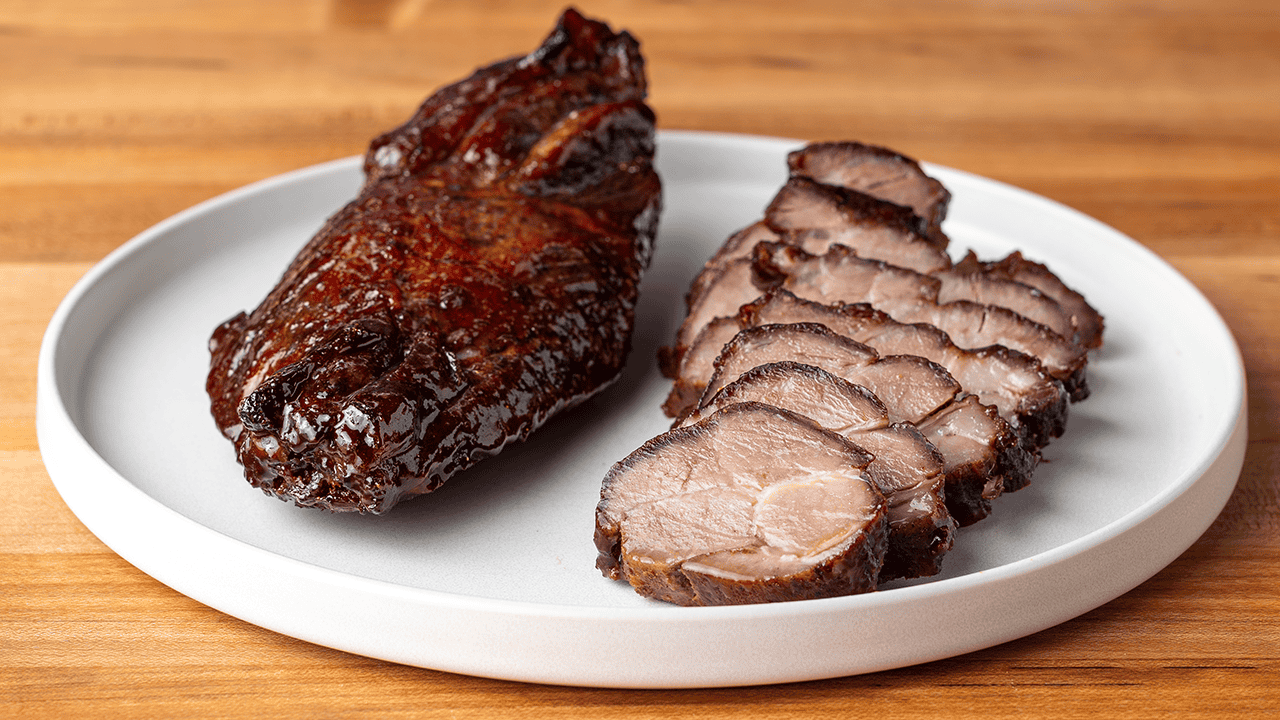
- The glaze is maltose and reserved marinade only. Two thin coats of warmed maltose and reserved marinade, each set at 350°F, produce the shiny, glossy lacquer you see at Hong Kong BBQ shops. Water thins it out and honey stays tacky, so the traditional maltose combination is worth finding.
- Red yeast rice provides natural color without changing the flavor. The deep red on traditional char siu comes from red yeast rice powder. The neon red at some takeout shops is typically made with food dye. A quarter teaspoon of red yeast rice gives you a natural, soft red.
- Longer marination doesn't mean more flavor. Marinade only penetrates about an eighth of an inch, so going past 24 hours doesn't get the flavor any deeper and can actually toughen the meat. The tenderness comes from how it's cooked.
Ingredients You'll Need
There are really only four ingredients in this recipe that you probably haven't cooked with before. The rest of the marinade is regular grocery store stuff: hoisin, soy sauce, oyster sauce, brown sugar, five-spice, garlic, white pepper, sesame oil. Here's what you'll want to track down at an Asian grocery store.
Red Fermented Bean Curd (Nam Yu, 南乳)
This is the most important ingredient in the marinade. It gives char siu that distinct fermented flavor most people recognize from Chinese BBQ shops but can never quite put your finger on. You'll find it in the preserved foods aisle at an Asian grocery store. Two types of jars both say "red bean curd" on the label: one gets its color from red yeast (that's what you want) and the other gets it from chili (that one adds heat). Check the ingredient list for red yeast rice if you're not sure which you're holding.
Red Yeast Rice Powder (紅曲米)
This is the natural colorant that gives char siu its red tint without changing the flavor. It comes as small grains of rice, so grind it to a powder in a mortar and pestle before adding it. If you can't find it, a couple drops of red food color gets you the standard takeout red. Either way, this is purely cosmetic.
Chinese Rose Wine (玫瑰露酒)
A clear cooking wine sweetened with sugar and infused with rose petals. It adds a slight floral note to the marinade. The English spellings vary (Mai Que Lo, mei kuei lu, and others), so check the label for "rose" in the ingredients. You'll usually find it next to the Shaoxing and Michiu. If you can't find it, Shaoxing cooking wine is a solid 1:1 substitute.
Maltose (麥芽糖)
A thick, sticky malt sugar that Chinese BBQ shops use to lacquer their char siu. You'll find it near the honey or syrups at the Asian market. Maltose browns at a higher temperature than honey and sets to a firm, glossy finish instead of staying tacky. Honey is the 1:1 substitute by weight and a tradition of its own (honey char siu, 蜜汁叉燒). If you go with maltose, wet your hands before handling it. It is genuinely the stickiest substance you will ever work with.
How to Make Char Siu
The full ingredient list and step-by-step measurements are in the recipe card below. This walkthrough covers the technique and what to watch for at each stage.
1. Cut the pork with the grain.
Find the direction the muscle fibers run and slice with them, not across them. You want strips about an inch and a quarter to an inch and a half thick. Even thickness matters more than neat shapes; strips that vary will finish at different times. You'll slice the other direction, across the grain, after it's cooked, and that's what makes each piece tender instead of chewy.
2. Mix the marinade and reserve two tablespoons for the glaze.
Mash the fermented bean curd into a paste first, then whisk in the rest of the marinade ingredients until everything is smooth. Before any of it touches the raw pork, scoop out two tablespoons and refrigerate them in a separate container. That reserved portion stays clean and goes into the glaze at the end.
3. Marinate overnight.
Coat the strips and refrigerate them for 8 to 24 hours. Going longer than a day doesn't get the flavor any deeper and can start to toughen the meat.
4. Temper, then roast at 225°F, covered.
Take the pork out about an hour before cooking so it comes closer to room temperature. Lay the strips on a foil-lined sheet pan with space between them, cover loosely with a second sheet of foil, and roast at 225°F. The loose cover holds in moisture through the long cook.
5. Ride out the stall.
When the internal temperature hits the 150s, it'll slow down and barely move for what feels like too long. This is the stall, and it's the most important part of the entire cook. The collagen is converting to gelatin during this stretch, and that conversion is what makes the meat tender. Do not raise the heat to speed it up.
6. Pull at 180°F, drain, and dry.
When the center of the thickest strip reaches 180°F, take the pork off the pan and pour off the rendered liquid (save it for char siu sauce). Pat the strips as dry as you can, lay them on fresh foil, and raise the oven to 350°F. The glaze only sticks to a dry surface; on a wet one it runs off and pools.
7. Glaze in two thin coats.
Microwave the maltose and reserved marinade together for about 30 seconds and whisk them smooth. Brush the strips on all sides, slide them into the 350°F oven for 3 minutes to set the first coat, then pull them out, brush on a second coat, and return for another 3 minutes. Two thin coats is the limit on strips this size; more just pools on the curves.
8. Optional: broiler char for blackened edges.
If you want the traditional blackened edges (焦邊), switch to broil and watch it every 30 to 60 seconds. The sugar goes from caramelized to burnt faster than you'd expect. This step is optional. The 350°F glaze set usually gives good color and sheen on its own.
9. Rest, then slice across the grain.
Rest the pork for 10 to 15 minutes, then turn each strip 90 degrees from how you originally cut it and slice thin across the grain. Slicing against the fibers is what makes each piece tender.
Tips for the Best Char Siu
Get the fatty cut. You want a well-marbled Boston butt that's close to half fat and half lean. The fat renders during the long cook and keeps the pork juicy from the inside. Lean cuts like loin or tenderloin dry out fast because there isn't enough intramuscular fat to compensate for the hours of heat.
Use a probe thermometer. On a cook that runs anywhere from 2 to 5 hours, knowing the exact internal temperature keeps you from pulling it too early or leaving it in too long. A leave-in probe thermometer is ideal for this recipe because it monitors the center of the pork the whole time without you opening the oven. If you don't have a leave-in probe, start checking with an instant-read thermometer once you're past the 2-hour mark, then every 30 minutes or so until you hit 180°F in the center.
Drain and dry before glazing. The pork renders a lot of liquid during the low-and-slow cook. If you brush the glaze onto a wet surface, it runs right off. Pour off the liquid, pat the strips dry, and lay them on fresh foil before the first coat.
Two thin coats, not one thick one. Each coat gets 3 minutes at 350°F to set before the next one goes on. A thick single coat pools on the curves and never firms up. Two thin coats is how the BBQ shops do it.
Save the pan drippings for char siu sauce. The rendered liquid from the cook has a lot of flavor from the marinade and the pork fat. Strain it into a small saucepan and reduce it slightly. Spoon it over sliced char siu and steamed rice, the way many BBQ shops serve it.
The broiler is the riskiest step. If you go for blackened edges, watch it constantly. The maltose goes from caramelized to burnt in seconds, and every broiler heats differently. Pull it the moment the color looks right to you.
What to Serve With Char Siu
Char siu is traditionally served sliced over steamed rice with blanched greens and char siu sauce spooned on top.
I grew up eating it inside egg rolls and wonton soup before I ever had it on its own. Diced char siu mixed into an egg roll filling adds a rich sweetness that plain ground pork doesn't have, and thin slices in wonton soup give you something substantial to pull out of the broth.
It also works well in fried rice. Dice it and toss it in toward the end so the edges get a little crispy in the wok. Lo mein and chow mein are also good options, where the sweetness from the char siu glaze goes well alongside a savory noodle sauce.
Storage and Reheating
Char siu keeps 3 to 4 days in the refrigerator and 2 to 3 months in the freezer. Wrap portions in foil or seal them in freezer bags. You can also freeze the raw marinated pork before cooking, which makes this a good protein to prep ahead for the week.
Reheat in a hot oven (375°F for about 10 minutes) or an air fryer to re-crisp the lacquered edges. A microwave at 50 to 60% power keeps the meat tender but won't bring back the crispness on the outside. Slice only what you plan to eat; cut surfaces dry out faster than whole pieces.
Frequently Asked Questions
Can I use pork loin or tenderloin instead of shoulder?
You can, but the result will be quite different. Loin and tenderloin are lean cuts with very little connective tissue, so they cook quickly and don't need the low-and-slow method. The tradeoff is they dry out much faster because there isn't enough intramuscular fat to keep them juicy over a long cook. If you use a lean cut, roast at a higher temperature for a shorter time and pull it at 145°F to 150°F instead of 180°F.
What is nam yu (red fermented bean curd)?
Nam yu (南乳) is tofu that's been fermented with red yeast, salt, and rice wine. It has a strong, savory flavor with a fermented funk somewhat similar to miso or aged cheese in concept, though the actual taste is its own thing. It's the ingredient that gives restaurant char siu that recognizable savory quality most home versions are missing. Look for jars labeled "red bean curd" or "fermented bean curd" at an Asian grocery store, and make sure the color comes from red yeast, not chili.
Can I substitute honey for maltose?
Yes. Honey is a 1:1 substitute by weight and a legitimate tradition (honey char siu, 蜜汁叉燒). The practical difference is that honey stays slightly tacky and browns faster, while maltose sets to a harder, glossier finish and gives you more control near the broiler. Both produce good char siu.
Why did my char siu come out dry?
Most likely the cook. If the oven was too hot or the pork didn't spend enough time in the low temperature range, the collagen in the shoulder never had a chance to convert to gelatin. The other common cause is the cut: lean loin or tenderloin doesn't have enough fat or connective tissue to stay juicy through a long cook. For tender char siu, use a well-marbled pork shoulder and roast at 225°F until the center reaches 180°F, even if it takes 4 or 5 hours.
Do I need an Asian grocery store for this?
For the best version, yes. Red fermented bean curd, red yeast rice powder, rose wine, and maltose are specialty ingredients most Western grocery stores don't carry. The good news is you only need small amounts of each, and they last a long time once you buy them. If you can't get to an Asian market, Shaoxing wine replaces rose wine, honey replaces maltose, and the dish still works without red yeast rice (it's just color). The one ingredient with no close substitute is the nam yu. Without it, the char siu will taste more like generic sweet-soy pork.
More Chinese Recipes
More Chinese Takeout Recipes
- Chinese Takeout Egg Rolls
- Chinese Takeout Wonton Soup
- Chinese Takeout Fried Rice
- Chinese Takeout Lo Mein
- Chinese Takeout Chow Mein
Recipe
Char Siu (Chinese BBQ Pork)
Equipment
- 1 Baking Sheet Foil-lined
- 1 Mortar & Pestle Grind the red yeast rice to powder
- 1 Whisk
- 1 Microplane Grater For the garlic
- 1 Tongs
- 1 Leave-In Probe Thermometer Push into thickest strip at the start of the cook
- 1 Instant-read thermometer For spot-checking if you don't have a leave-in probe
Ingredients
The Pork
- 2 lb boneless pork shoulder Boston butt, well-marbled (about half fat), fat cap on; cut into 1¼ to 1½ inch strips with the grain.
The Marinade
- 3 tablespoon hoisin sauce
- 2-4 cubes red fermented bean curd nam yu (南乳), about 40g, mashed. Buy the yeast-reddened type, not the chili type.
- 1 teaspoon red fermented bean curd brine from the jar
- 2 tablespoon light soy sauce Chinese light soy (生抽)
- 1 teaspoon dark soy sauce for color (老抽)
- 1 tablespoon oyster sauce
- 2 tablespoon brown sugar
- 1 ½ tablespoon rose wine 玫瑰露酒; Shaoxing or dry sherry as a 1:1 substitute
- 1 teaspoon five-spice powder
- 3 cloves garlic grated
- ¼ teaspoon white pepper ground
- 1 teaspoon sesame oil toasted
- ¼ teaspoon MSG Aji-No-Moto
- ½ teaspoon red yeast rice powder 紅曲米, ground to a powder first; ¼ to ½ teaspoon to taste, purely for color. Or a couple drops of red food color for the bright takeout look. Optional.
The Glaze
- 3 tablespoon maltose 麥芽糖; honey is a 1:1 substitute by weight. Wet your hands or spoon so it doesn't weld to them.
- 2 tablespoon reserved marinade the 2 tablespoon set aside before the marinade touched the pork. Microwave the two together ~30 sec and whisk smooth.
Instructions
Cut and Marinate
- Cut the pork into long strips 1¼ to 1½ inches thick, cutting with the grain and leaving the fat cap on. Keep the thickness even so the strips finish cooking together; the shape doesn't matter.
- Stir all marinade ingredients together until the bean curd breaks up smooth. Set aside 2 tablespoons in a covered container in the fridge before the marinade touches the pork. That clean portion becomes the glaze.
- Coat the strips in the remaining marinade in a zip-top bag or covered dish and refrigerate 8 to 24 hours. Marinade only seasons the surface, so a longer soak doesn't go deeper and can toughen the meat.
Before Roasting
- Take the pork out of the fridge about 1 hour before cooking so it roasts evenly instead of cooking from cold on the outside first.
- Heat the oven to 225°F. Line a sheet pan with foil, lay the strips flat with space between them, and tent loosely with a second sheet of foil to hold in moisture.
Roast Low and Slow
- Roast at 225°F until the thickest strip reads 180°F in the center, anywhere from 2 to 5 hours depending on cut size and fat. Go by temperature, not the clock.
- Expect a long stall in the 150s where the temperature barely moves. That stall is the connective tissue converting to gelatin, which is what makes the pork tender, so do not raise the heat to rush it.
Glaze and Finish
- While the pork roasts, microwave the maltose and reserved marinade together about 30 seconds and whisk into a smooth glaze. No water; the marinade is the only thinner it needs.
- At 180°F, uncover, lift the strips off the pan, and pour off the pooled liquid (save it for char siu sauce). Pat the strips very dry and raise the oven to 350°F. A dry surface takes the glaze; a wet one sheds it.
- Brush the strips with glaze, return to the 350°F oven about 3 minutes to set, then brush a second coat and give it another 3 minutes. Two thin coats build the glossy lacquer.
- Optional: for blackened edges, switch to broil for short bursts at the very end, watching every 30 to 60 seconds. The sugar goes from caramelized to burnt in seconds.
Rest and Serve
- Rest the pork 10 to 15 minutes, then slice thin across the grain so each piece comes out tender instead of chewy.
- For char siu sauce, strain the reserved pan liquid into a small saucepan and reduce slightly to concentrate it. Spoon over the sliced pork or over steamed rice.