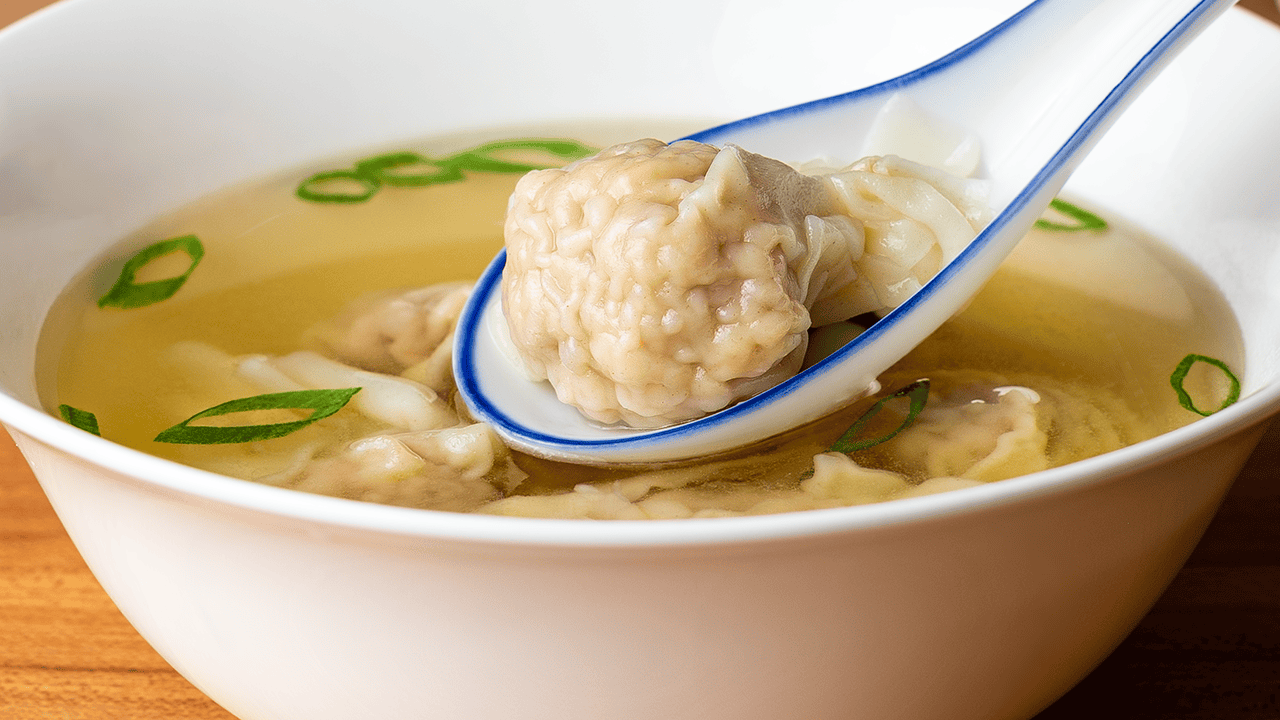
If your homemade wonton soup broth doesn’t taste like takeout, you’re probably using the wrong chicken broth. Western-style stock uses mirepoix, parsley, and black peppercorns. Asian-style chicken bouillon is a completely different flavor profile: mostly chicken, sometimes green onion and ginger, and none of the herbs and vegetables that make it taste like something else entirely. After visiting hundreds of takeout kitchens over the years, I found the same two brands in almost all of them: Knorr chicken flavor broth mix and Lee Kum Kee chicken bouillon powder.
If you’ve tried making wonton soup at home and the broth never tasted quite right, the recipe you followed probably started with the wrong base. This version covers the full takeout wonton soup from scratch: two broth options (a 5-minute basic version and a 30-minute aromatic infusion with Shaoxing wine), a classic pork and shrimp filling with the one-direction mixing technique that gives you that bouncy takeout texture, two traditional folding shapes, and a bonus Fuchsia Dunlop sweet chili oil sauce that might be the best use of leftover frozen wontons you’ll ever find.
This post contains affiliate links, which means I may earn a small commission if you make a purchase. It doesn’t cost you anything extra.Full disclosure.
Why This Wonton Soup Recipe Works
Asian chicken bouillon, not Western stock. The two most common brands in takeout kitchens are Knorr and Lee Kum Kee. Western broths use mirepoix and herbs like thyme and rosemary. That’s why your homemade version doesn’t taste right.
One-direction hand mixing, not a food processor. Stirring the pork and shrimp filling in a single direction for several minutes creates microscopic protein strands that give you the bouncy, springy texture of takeout wontons. A food processor breaks those structures down instead of forming them.
Wontons cooked separately from the broth. The wrappers are dusted in starch to keep them from sticking in the package. Cooking them directly in the broth clouds the liquid and turns it thick. Every takeout kitchen uses two pots: one for boiling wontons, one for the broth.
Aromatic infusion with Shaoxing wine, not just seasoned water. The basic broth takes 5 minutes and uses bouillon powder with seasonings. The upgraded version adds garlic, ginger, and scallion whites simmered for 30 minutes with a splash of Shaoxing wine, which is what you’ll find at more upscale Chinese restaurants.
Two folding shapes with different filling amounts. The cloud shape uses about 1 teaspoon of filling and gives you those billowy tops. The water caltrop shape uses 2-3 teaspoons and looks like a gold ingot. Both are classic takeout styles.
Ingredients You’ll Need
Asian chicken bouillon powder. This is the single biggest difference between your wonton soup and the takeout version. You want the kind with Chinese characters on the packaging. Lee Kum Kee chicken bouillon powder and Knorr chicken flavor broth mix are the two brands I see most often in real takeout kitchens. Western bouillon powders include vegetables like carrots and parsley that aren’t part of Asian broths, and the flavor is noticeably different. Western-style broth will work if that’s all you can find, but you won’t get that classic takeout flavor.
Ground pork. Get the fattiest version you can find. The extra fat helps the filling mixture emulsify when you do the one-direction stir, and it keeps the inside of the wontons juicy after they cook. Lean ground pork gives you dry, crumbly filling that falls apart.
Shrimp. You’ll peel and devein them first, then mince them as fine as you can until the shrimp is almost a paste. The shrimp plumps up during cooking and gives you that traditional springy texture alongside the pork. If you have a shellfish allergy, you can leave the shrimp out entirely or substitute ground chicken thigh. Ground chicken breast tends to dry out, so stick with thigh meat if you go that route.
Wonton wrappers. You want the white, extra-thin variety. The most common brand in takeout kitchens is Twin Marquis Extra Thin. If you can’t find that specific brand, any square, white, thin wonton wrapper will work. There are two main styles at Asian grocery stores: yellow wrappers (Hong Kong/Southern Chinese style) and white wrappers (Northern Chinese style). Most American takeout places use the white ones. Keep unused wrappers under a damp towel while you work so they don’t dry out and crack.
Shaoxing wine. Used in both the filling and the infused broth. It adds depth and a slight sweetness that rounds out the rest of the flavors. Dry sherry works as a substitute if you can’t find Shaoxing.
How to Make Wonton Soup
1. Make the broth. For the basic version, heat 6 cups of water to a simmer, whisk in the chicken bouillon powder until dissolved, then add the seasonings (salt, MSG, sugar, white pepper, soy sauce, sesame oil). That’s it. For the infused version, you’ll add lightly smashed garlic, ginger, and scallion whites to the broth and simmer them for 30 minutes before adding the seasonings and Shaoxing wine. Lightly pounding the aromatics before adding them helps release more flavor by rupturing some of the cell walls. Keep the broth just below a simmer during infusion. If it’s at a rolling boil, it’ll reduce too much and become overly concentrated.
2. Make the filling. Finely mince the shrimp until it resembles a paste and combine it with the ground pork in a large bowl. Add all the seasonings (salt, sugar, MSG, white pepper, grated garlic, grated ginger, cornstarch, sesame oil, soy sauce, Shaoxing wine, water, chicken bouillon powder, and minced scallions). Squeeze everything together with your hand until it’s well incorporated. The mixture will look like it has too much liquid at first, but it will eventually emulsify into the filling as you work it.
3. One-direction stir. Using your hand, stir the mixture in one direction for several minutes until you notice little strands developing in the filling. This is the step that gives you the bouncy texture. You’ll know it’s ready when you can see what look like tiny threads in the meat. You can use the filling right away or store it in the fridge for up to 2 days.
4. Fold the wontons. For the cloud shape, place a wrapper like a diamond, put about 1 teaspoon of filling in the center, wet two edges, fold the bottom corner to meet the top, press around the filling to remove air, then bring both sides up to meet at the top. For the water caltrop shape, use 2-3 teaspoons of filling, wet all four edges, fold into a triangle, press out the air, then bring the two bottom corners together and overlap them. The main reason wontons come apart during cooking is too much trapped air, so press it out around the filling before you seal them.
5. Cook the wontons separately. Bring a pot of water to a boil, then lower the heat to a simmer. Drop in the wontons and give them a stir right away so they don’t sink and stick to the bottom. Cook for 4-6 minutes. A lot of recipes say they’re done when they float, but a more reliable sign is when the wrappers turn translucent and you can see the filling has plumped up inside.
6. Assemble. Drain the cooked wontons thoroughly and place them in a bowl. Pour hot broth over the top and garnish with thinly sliced scallions.
Tips for the Best Wonton Soup
Cook the wontons right before serving. If they sit in the broth for too long, the wrappers absorb liquid and turn thick and gummy. This is actually why a lot of takeout wonton soup doesn’t taste as good as it should: the wontons were made hours ago and have been sitting in the broth all day. If you’re meal prepping, store the broth and frozen wontons separately and combine them when you’re ready to eat. The whole thing comes together in about 10 minutes from frozen.
Keep the cooking water at a simmer, not a rolling boil. A rapid boil is one of the main reasons wontons burst open. You want them to cook gently so the wrappers stay intact. If you’re cooking from frozen, add 1-2 extra minutes to the cook time.
Err on the side of less filling. The meat expands while cooking, and if there’s trapped air inside, the wonton can plump up and burst. For cloud-shaped wontons, about 1 teaspoon is about right. For water caltrop, 2-3 teaspoons. If you’re not sure, go with less.
Freeze extras in a single layer. Line a baking sheet with parchment paper, place the wontons so they’re not touching, cover with plastic wrap, and freeze for about 2 hours. Once they’re frozen solid, transfer them to a ziplock bag to save space. They’ll keep for 2-3 months and should be cooked directly from frozen without thawing.
Bonus: Fuchsia Dunlop’s Sweet Chili Oil Wontons
This recipe comes from Fuchsia Dunlop’s Every Grain of Rice, which is one of my favorite cookbooks. These are the same wontons prepared exactly as above, but instead of broth, they’re doused in a sweet aromatic soy sauce with chili oil and crispy garlic. The sauce is made by simmering soy sauce and water with cinnamon, fennel seeds, star anise, Sichuan peppercorns, and ginger for 30 minutes, then whisking in brown sugar and straining out the spices. The sauce keeps in the fridge pretty much indefinitely. Layer cooked wontons in a bowl, pour over the sauce, add some chili oil and crispy garlic, and top with sliced scallions. If you have frozen wontons on hand, this is a 10-minute meal that I’d put up against most dishes at a sit-down restaurant.
Storage and Reheating
The broth can be stored in a covered container in the fridge for 3-5 days, or frozen for up to 3 months. Store broth and wontons separately. Uncooked wontons can be frozen on a parchment-lined baking sheet, then transferred to a freezer bag once solid. They’ll keep for 2-3 months. Cook directly from frozen (do not thaw first). Cooked wontons don’t store well because the wrappers get soft and gummy, so make them fresh right before eating.
The Fuchsia Dunlop sweet aromatic soy sauce keeps in the fridge pretty much indefinitely.
Frequently Asked Questions
Can I use Western-style chicken broth instead of Asian bouillon?
You can, but it’ll taste different. Western broths use a mirepoix base (onions, carrots, celery) and often include herbs like thyme, parsley, and bay leaves. Asian chicken bouillon is simpler: mostly chicken, sometimes green onion and ginger. The Western herbs and vegetables add flavors that aren’t part of the takeout wonton soup profile. It’ll still taste good, just not like what you get at a Chinese restaurant.
Why did my wontons fall apart?
Three common causes: too much air trapped inside (press it out when folding), cooking water at too high a boil (keep it at a gentle simmer), or the edges weren’t sealed properly (wet the wrapper edges with water before folding). Also give the wontons a gentle stir right after you add them to the pot so they don’t stick to the bottom and tear.
Can I make the wontons in a food processor?
I wouldn’t recommend it. The one-direction hand mixing creates microscopic protein strands that give you that bouncy, springy texture. A food processor chops the meat too fine and breaks down those protein structures rather than letting them form. You want a paste that’s sticky and slightly spongy, not a smooth puree.
Why do you add water and chicken bouillon powder to the filling?
The liquid keeps the filling juicy after cooking. As you stir the mixture in one direction, the proteins create a matrix that traps the liquid inside. This is the same technique used across Chinese dumpling making to keep the filling from drying out. It might look like too much liquid at first, but it all gets absorbed as you mix.
Can I add noodles to make wonton noodle soup?
Yes. Cook the noodles in a separate pot of water (not in the broth) and add them to the bowl along with the cooked wontons before pouring over the broth. If you cook the noodles directly in the broth, the starch will cloud it the same way cooking wontons in the broth does.
Chinese takeout wonton soup with two broth versions (basic 5-minute and aromatic infused), a classic pork and shrimp filling using the one-direction mixing technique for that signature bouncy texture, and two traditional folding shapes. Developed after visiting hundreds of takeout kitchens and identifying the key difference most home cooks miss: Asian-style chicken bouillon powder instead of Western stock. Includes a bonus Fuchsia Dunlop sweet aromatic soy sauce for chili oil wontons. Serves 4-6.
Course Appetizer, Main Course, Soup
Cuisine Chinese-American
Keyword chinese takeout soup, chinese wonton soup, homemade wontons, pork shrimp wontons, wonton soup, wonton soup broth, wonton soup recipe
Heat 6 cups of water in a large pot or saucepan until simmering. Add the chicken bouillon powder and whisk until completely dissolved. Kill the heat.
Add the table salt, MSG, sugar, white pepper, and soy sauce. Whisk until all seasonings are dissolved. Add the toasted sesame oil and whisk until evenly distributed.
Taste the broth and adjust the seasoning with extra salt, MSG, sugar, or soy sauce if needed. Once cooled, store in a covered container in the fridge for 3-5 days or freeze for up to 3 months.
Make the Infused Broth (Upgrade)
Heat 6 cups of water in a large pot or saucepan until simmering. Add the chicken bouillon powder and whisk until completely dissolved. Lower the heat until the broth is just below a simmer.
Add the lightly smashed garlic, ginger, and scallion whites to the broth. Lightly pounding them before adding helps release more flavor by rupturing some of the cell walls. Infuse the aromatics for 30 minutes, keeping the heat just below a simmer. If the broth is at a rolling boil, it will reduce too much and become overly concentrated.
Remove the aromatics from the broth and turn off the heat. Add the table salt, MSG, sugar, white pepper, soy sauce, Shaoxing wine, and toasted sesame oil. Whisk until all seasonings are dissolved.
Taste the broth and adjust the seasoning if needed. Once cooled, store in a covered container in the fridge for 3-5 days or freeze for up to 3 months.
Make the Wonton Filling
Peel and devein the shrimp, then finely mince them until the shrimp resembles a paste. You want it as fine as you can get it. Add the minced shrimp and ground pork to a large bowl.
Add the table salt, sugar, MSG, white pepper, grated garlic, grated ginger, cornstarch, toasted sesame oil, soy sauce, Shaoxing wine, water, chicken bouillon powder, and minced scallions to the bowl.
Squeeze everything together with your hand until the ingredients are well incorporated. The mixture will look like it has too much liquid at first, but it will emulsify into the filling as you work it.
Using your hand, stir the mixture in one direction for several minutes until you see little strands developing in the filling. These microscopic protein links give you the bouncy, springy texture of takeout wontons. The filling is ready when you can see tiny thread-like strands in the meat. Use immediately or refrigerate for up to 2 days.
Fold the Wontons (Cloud Shape)
Place a wonton wrapper in front of you like a diamond. Put about 1 teaspoon of filling in the center. Wet two edges of the wrapper with water.
Bring the bottom corner up to meet the top corner and lightly press the edges together to seal. Press down around the filling to remove as much air as possible, forming a small ball at the bottom of the dumpling. Bring both sides up to meet at the top and lightly press them together.
Fold the Wontons (Water Caltrop Shape)
Place a wonton wrapper in front of you like a diamond. Put about 2-3 teaspoons of filling in the center. Wet all four edges with water.
Bring the bottom corner up to the top corner and press down on both sides to form a triangle. Press down around the filling to remove as much air as possible. Place the dumpling in your hand with the top corner facing your thumb.
Wet one of the bottom corners with water. Bring the dry corner around the bottom so it overlaps with the wet corner and press them together. Pull the top flap up if it has folded down. The finished dumpling should have a slight dimple at the bottom.
Cook the Wontons
Bring a large pot of water to a boil, then lower the heat to a simmer. Gently drop the wontons into the simmering water. Stir them gently right away so they don’t sink and stick to the bottom.
Cook for 4-6 minutes. You’ll know they’re done when the wrappers turn translucent and you can see the filling has plumped up inside. For frozen wontons, add 1-2 extra minutes.
Remove the wontons from the water with a spider strainer or slotted spoon. Drain them thoroughly.
Assemble the Wonton Soup
Place the cooked, drained wontons in a large bowl. Pour hot broth over the wontons until they’re covered. Garnish with thinly sliced scallions and serve immediately.
Group 8: Make Fuchsia Dunlop's Sweet Aromatic Soy Sauce (Bonus)
Add the soy sauce and water to a small pot or saucepan and bring to a boil. Add the cinnamon stick, fennel seeds, star anise, Sichuan peppercorns, and lightly crushed ginger. Lower the heat to a gentle simmer and infuse the aromatics for 30 minutes.
Kill the heat and whisk in the brown sugar until dissolved. Strain the sauce through a fine mesh strainer to remove the spices. Store in a covered container in the fridge pretty much indefinitely.
To serve, layer cooked wontons in a bowl and pour the sweet aromatic soy sauce over them. Add chili oil and crispy garlic, then top with thinly sliced scallions.
Video
Notes
Which broth version should I make? The basic broth takes about 5 minutes and uses just bouillon powder and seasonings. It’s what most takeout places actually use. The infused version adds garlic, ginger, scallion whites, and Shaoxing wine simmered for 30 minutes, which gives you a more complex flavor that you’ll find at higher-end restaurants. Both are included so you can choose based on how much time you have.Why Asian chicken bouillon instead of regular chicken broth? Western chicken broths and bouillon powders are made with mirepoix (onions, carrots, celery) and often include herbs like parsley, thyme, and rosemary. Asian chicken bouillon is a simpler flavor profile: mostly chicken, sometimes with green onion and ginger. That difference is the main reason homemade wonton soup doesn’t taste like takeout. The two most common brands in takeout kitchens are Knorr and Lee Kum Kee.Why stir the filling in one direction? Stirring in one direction creates microscopic links of protein in the meat mixture. These protein strands give you the characteristic bouncy, springy texture of takeout-style wontons. Using a food processor will break down these structures instead of building them.Why cook the wontons separately from the broth? Wonton wrappers are dusted in starch to prevent them from sticking together in the package. If you cook them directly in the broth, that starch clouds the liquid and can make the broth thick and gummy. Every wonton noodle house uses separate pots: one for cooking the wontons, one for the broth.Shellfish allergy substitution. Leave out the shrimp entirely or substitute ground chicken thigh. Ground chicken breast tends to dry out more, so thigh meat is a better option. The wontons will still have good flavor from the pork and seasonings, but the filling won’t have quite the same springy texture that shrimp provides.Freezing wontons. Line a baking sheet with parchment paper and place the uncooked wontons flat so they are not touching. Cover with plastic wrap and freeze for 1-2 hours. Once frozen, transfer to a freezer bag to save space. Wontons will keep in the freezer for 2-3 months and should be cooked directly from frozen without thawing.How to tell when wontons are done. Floating is one indicator, but a more reliable sign is when the wrappers turn mostly translucent and you can see that the filling has plumped up inside. This usually takes 4-6 minutes for fresh wontons and 5-8 minutes for frozen.About the Fuchsia Dunlop sauce. This recipe is adapted from Every Grain of Rice by Fuchsia Dunlop (page 322). The sauce keeps in the fridge pretty much indefinitely and is one of the best things you can do with leftover frozen wontons. It is excellent.
If your homemade wonton soup broth doesn’t taste like takeout, you’re probably using the wrong chicken broth. Western-style stock uses mirepoix, parsley, and black peppercorns. Asian-style chicken bouillon is a…
Most General Tso’s chicken you get from a takeout place is too sweet, with soggy chicken and no crunch. The meat is tough, the crust has no texture, and the…
Chinese takeout egg drop soup is one of those dishes that sounds impossible to mess up. It’s broth and eggs. But if you’ve made it at home and ended up…
I hate Spam as much as you do. So, I'll never share your address or send you advertisements. Just the occasional update and the inside scoop on new recipes.
Heat 6 cups of water in a large pot or saucepan until simmering. Add the chicken bouillon powder and whisk until completely dissolved. Kill the heat.
2
Add the table salt, MSG, sugar, white pepper, and soy sauce. Whisk until all seasonings are dissolved. Add the toasted sesame oil and whisk until evenly distributed.
3
Taste the broth and adjust the seasoning with extra salt, MSG, sugar, or soy sauce if needed. Once cooled, store in a covered container in the fridge for 3-5 days or freeze for up to 3 months.
4
Heat 6 cups of water in a large pot or saucepan until simmering. Add the chicken bouillon powder and whisk until completely dissolved. Lower the heat until the broth is just below a simmer.
5
Add the lightly smashed garlic, ginger, and scallion whites to the broth. Lightly pounding them before adding helps release more flavor by rupturing some of the cell walls. Infuse the aromatics for 30 minutes, keeping the heat just below a simmer. If the broth is at a rolling boil, it will reduce too much and become overly concentrated.
6
Remove the aromatics from the broth and turn off the heat. Add the table salt, MSG, sugar, white pepper, soy sauce, Shaoxing wine, and toasted sesame oil. Whisk until all seasonings are dissolved.
7
Taste the broth and adjust the seasoning if needed. Once cooled, store in a covered container in the fridge for 3-5 days or freeze for up to 3 months.
8
Peel and devein the shrimp, then finely mince them until the shrimp resembles a paste. You want it as fine as you can get it. Add the minced shrimp and ground pork to a large bowl.
9
Add the table salt, sugar, MSG, white pepper, grated garlic, grated ginger, cornstarch, toasted sesame oil, soy sauce, Shaoxing wine, water, chicken bouillon powder, and minced scallions to the bowl.
10
Squeeze everything together with your hand until the ingredients are well incorporated. The mixture will look like it has too much liquid at first, but it will emulsify into the filling as you work it.
11
Using your hand, stir the mixture in one direction for several minutes until you see little strands developing in the filling. These microscopic protein links give you the bouncy, springy texture of takeout wontons. The filling is ready when you can see tiny thread-like strands in the meat. Use immediately or refrigerate for up to 2 days.
12
Place a wonton wrapper in front of you like a diamond. Put about 1 teaspoon of filling in the center. Wet two edges of the wrapper with water.
13
Bring the bottom corner up to meet the top corner and lightly press the edges together to seal. Press down around the filling to remove as much air as possible, forming a small ball at the bottom of the dumpling. Bring both sides up to meet at the top and lightly press them together.
14
Place a wonton wrapper in front of you like a diamond. Put about 2-3 teaspoons of filling in the center. Wet all four edges with water.
15
Bring the bottom corner up to the top corner and press down on both sides to form a triangle. Press down around the filling to remove as much air as possible. Place the dumpling in your hand with the top corner facing your thumb.
16
Wet one of the bottom corners with water. Bring the dry corner around the bottom so it overlaps with the wet corner and press them together. Pull the top flap up if it has folded down. The finished dumpling should have a slight dimple at the bottom.
17
Bring a large pot of water to a boil, then lower the heat to a simmer. Gently drop the wontons into the simmering water. Stir them gently right away so they don't sink and stick to the bottom.
18
Cook for 4-6 minutes. You'll know they're done when the wrappers turn translucent and you can see the filling has plumped up inside. For frozen wontons, add 1-2 extra minutes.
19
Remove the wontons from the water with a spider strainer or slotted spoon. Drain them thoroughly.
20
Place the cooked, drained wontons in a large bowl. Pour hot broth over the wontons until they're covered. Garnish with thinly sliced scallions and serve immediately.
21
Add the soy sauce and water to a small pot or saucepan and bring to a boil. Add the cinnamon stick, fennel seeds, star anise, Sichuan peppercorns, and lightly crushed ginger. Lower the heat to a gentle simmer and infuse the aromatics for 30 minutes.
22
Kill the heat and whisk in the brown sugar until dissolved. Strain the sauce through a fine mesh strainer to remove the spices. Store in a covered container in the fridge pretty much indefinitely.
23
To serve, layer cooked wontons in a bowl and pour the sweet aromatic soy sauce over them. Add chili oil and crispy garlic, then top with thinly sliced scallions.