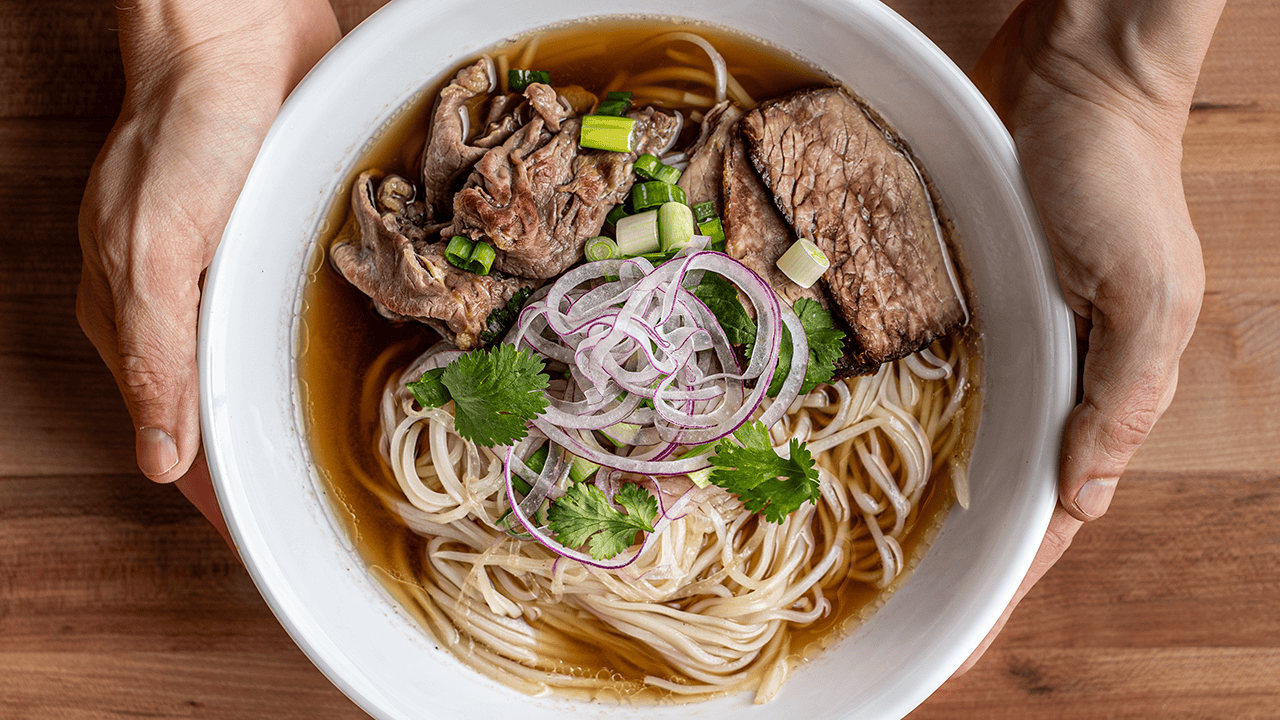
World-Class Beef Pho
Most beef pho recipes have you toss bones, spices, and aromatics into a pot and simmer everything together for hours. That approach works, but it limits what you can get out of the broth. The method in this beef pho recipe comes from Leighton Rossi, who runs Pho Queue Vietnamese Soup Kitchen in Australia and is one of the most respected pho makers I've come across. His 4-step blend method separates the base broth, spice infusion, pre-seasoning, and final adjustment into distinct stages, and the result is a pho that is in a different league from anything I've made before.
I want to be clear: this is Leighton's recipe. He was generous enough to answer my questions, walk me through his process, and give his blessing for me to share it. The biggest revelation for me was a Vietnamese seasoning called Hat Nem that virtually every pho recipe online leaves out entirely. Leighton says it's the difference between a good broth and a great one, and after tasting it firsthand, I can tell you he's right. If your homemade pho has always been missing something you couldn't quite identify, Hat Nem is almost certainly what's absent.
This post contains affiliate links, which means I may earn a small commission if you make a purchase. It doesn't cost you anything extra. Full disclosure.
Why This Beef Pho Recipe Works
- The 4-step blend method separates each layer of flavor. Instead of dumping everything in at once, you make a concentrated beef base first, then infuse spices and aromatics separately. Each component gets the exact cooking time it needs without compromising the others.
- Hat Nem is the restaurant seasoning most home recipes leave out. Salt, sugar, and fish sauce can only take a broth so far. Hat Nem is a Vietnamese seasoning powder that adds a savory layer that those three can't reach on their own. It's the difference between a good homemade broth and the one you remember from your favorite restaurant.
- The 3-hour infusion window is the peak extraction sweet spot. Brisket reaches ideal tenderness at about 3 hours. Spices hit maximum flavor at 2-3 hours before turning bitter. That overlap is why the recipe calls for exactly 3 hours.
- Blooming spices in beef tallow extracts more flavor than dry toasting. The volatile oils in the spices are fat-soluble, so toasting them in rendered beef fat carries and disperses the flavor compounds through the broth more effectively than water alone.
- A golden broth can be perfectly clear. Roasting the bones adds color, but the broth stays clean and unclouded. Some of the weakest pho Leighton has reviewed on his channel had broths that were completely colorless, because very little technique or effort went into the broth.
Ingredients You'll Need
Beef bones. The recipe calls for 11 pounds (5 kg) of beef bones. Marrow bones give the richest, most meaty result. If you can only find mixed "soup bones" (a combination of leg, knuckle, and neck bones), those work well too. Avoid using only neck bones, which produce a thinner broth with less collagen. If your regular grocery store doesn't carry beef bones, try a Hispanic carniceria or an Asian market.
Brisket. About 1 pound for the well-done sliced meat in the finished bowls. The brisket simmers in the broth during the infusion stage, so it absorbs all the pho flavors while it cooks. Chuck roast is a less expensive substitute. Avoid rump, which tends to come out dry and flavorless after simmering.
The four spices. Black cardamom, star anise, Saigon cinnamon, and cloves. These are the Southern Vietnamese pho spices. Black cardamom (not green) has a smoky, woody flavor that's essential to pho. Green cardamom is sweet and floral, better suited for desserts and Indian cuisine. If your store's packaging doesn't say "black cardamom," look for the scientific name Amomum costatum. For cinnamon, Saigon cinnamon is traditional, but whatever you have access to will work.
Hat Nem. This is the seasoning that separates restaurant pho from home versions. It translates roughly to "seasoning" and contains a blend of salt, sugar, MSG, and other ingredients that bring out flavor in a broth. You can find it at some Asian grocery stores labeled as "mushroom seasoning" or "vegetarian seasoning." Po Lo Ku Shitake Hat Nem is a good widely available option. Leighton also sells his own personal blend through his website at phoqueue.com.au.
Rock sugar. Less sweet than white granulated sugar, with a milder, almost mineral quality. White sugar is one-dimensional by comparison. You can find rock sugar at most Asian grocery stores.
Fish sauce. Used only as a finishing seasoning at the very end, not during cooking. Heating fish sauce for extended periods can make it sour and reduce its fragrance. Squid Brand is the most popular at Vietnamese restaurants: it's inexpensive and its only ingredients are anchovies, salt, and sugar. Red Boat is a higher-end first-press fish sauce, comparable to extra virgin olive oil in the fish sauce world.
Rare beef for serving. Eye of round is the traditional choice: lean, inexpensive, and easy to slice thin. Sirloin or tenderloin work for a more premium bowl. Freeze the meat for 10-15 minutes before slicing to firm it up. Asian grocery stores often carry pre-sliced hot pot beef that works perfectly.
Banh pho noodles. Thin Vietnamese rice noodles, about 1/16th of an inch thick. Fresh banh pho from the refrigerated section of an Asian grocery store is the best option and what most restaurants use. If using dried noodles, soak them in cold water for 1-2 hours before cooking to prevent clumping.
The herb plate. Scallions are mandatory. Beyond that, any combination of thinly sliced onion, Thai basil, cilantro, culantro (sawtooth herb), mint, bean sprouts, jalapenos, and lime. Thai basil has a purple stem and a medicinal, licorice-like flavor that's distinct from the green-stemmed sweet basil used in Western cooking. If a restaurant serves culantro with their pho, the place is almost always legit.
How to Make World-Class Beef Pho
This recipe has four stages spread over two days. Day one is the 24-hour bone broth. Day two is the spice infusion, seasoning, and assembly. It's a time investment, but most of it is hands-off.
Stage 1: The 24-Hour Beef Bone Base (Day 1)
Heat your oven as high as it will go (550°F / 290°C) and roast the bones in a roasting pan until they're well-browned, about 15-25 minutes. Roasting accomplishes everything blanching does (tightening proteins, removing impurities) but also adds color and intensifies flavor through browning.
Wash the scum off the roasted bones under running water, being careful not to dislodge any marrow. Place the bones in a large stock pot and add water at a 1:1 ratio (1 liter per kilogram of bones), plus 30% extra to account for evaporation over 24 hours. For 5 kg of bones, that's 5 liters plus about 1.5 liters extra.
Bring it to a light simmer, then drop the heat until you barely see a bubble. Set the lid slightly off the pot to allow some evaporation while preventing too much reduction. Simmer for 24 hours. The fat layer on top acts as insulation and prevents excessive evaporation. Skim any foam, but leave the fat.
After 24 hours, strain the broth into a container. Cool it rapidly using an ice bath (set the container inside a larger bowl of ice water). Transfer to the fridge overnight. The next day, scrape off the solidified fat layer and save it. That beef tallow is essential for the next stage.
This base is versatile. Anything you'd normally use beef stock for, this can replace. I use the same approach for my homemade ramen from scratch. It keeps about 5 days in the fridge and up to 12 months in the freezer.
Stage 2: Aromatics and Spice Infusion (Day 2)
Heat your oven to 550°F again. Salt the brisket on all sides and lay it in a roasting pan with the halved onion, halved shallot, halved ginger, and halved head of garlic. Roast until the brisket is browned, about 20-25 minutes. If you want to go traditional, you can also char the aromatics over an open flame afterward, but it's not required.
In a large pot, melt 6-8 tablespoons of the reserved beef tallow over medium heat. Sear the brisket on all sides until well-browned, then remove it. Kill the heat, let the fat cool slightly, then add the black cardamom, star anise, and cinnamon. Stir for 20-30 seconds until you smell their fragrance. Then add the cloves last (they're small and burn easily) and stir for another 20 seconds.
Add 2.5 liters of the beef base and the pre-seasoning: approximately 45 grams salt (add gradually, tasting as you go, until the broth is just on the edge of too salty), 40 grams rock sugar, and 20 grams Hat Nem. Stir until everything is dissolved.
Return the brisket and roasted aromatics to the pot. Bring to a very light simmer, then drop the heat to the faintest bubble you can manage. Infuse for exactly 3 hours. This is the same peak extraction concept I use in my Benihana hibachi onion soup: you want maximum flavor extracted before the ingredients start working against you.
Stage 3: Strain and Final Seasoning
After 3 hours, remove the brisket and set it aside for slicing later. Strain the broth and discard the aromatics and spices. Leave some fat in the broth for flavor.
Add the reserved half liter (500 ml) of beef base to bring the total up to about 3 liters. Then add 10 grams of rock sugar and 1 tablespoon plus 1 teaspoon (20 ml) of fish sauce. Stir until the sugar is dissolved.
Taste and adjust: if it's too salty, add more of the reserved broth. If it's underseasoned, add more salt or fish sauce. If it's not sweet enough, add a bit more rock sugar.
Stage 4: Bowl Assembly
Warm your bowls in a low oven for a couple of minutes. This is something the better pho restaurants do to serve at the ideal temperature.
Heat the broth in a small pot (about 500 ml per serving) until it just starts to simmer. Cook the noodles according to package directions and divide among the warm bowls. Layer thinly sliced rare beef and sliced well-done brisket on top of the noodles. Pour the simmering broth directly over the rare beef. The hot broth cooks the slices so they stay as tender as possible.
Top with your herb salad and serve with lime wedges on the side.
Tips for the Best Beef Pho
Don't rush the bone broth. The 24-hour simmer at the faintest bubble produces the most concentrated base. If you see heavy bubbling or steam, the heat is too high. You want almost no visible movement in the liquid.
Keep the fat layer intact during the base broth simmer. The rendered beef fat on top acts as a seal that prevents evaporation. If you skim the fat during the 24-hour cook, you'll lose broth volume and have to add water back, which dilutes the concentration. Save the skimming for after straining.
Toast the larger spices first, then the smaller ones. Black cardamom, star anise, and cinnamon can handle the heat. Cloves are small and burn quickly, which makes them bitter. Adding them 20 seconds after the larger spices is enough.
Season the broth aggressively during pre-seasoning. The broth should taste almost too salty before you add the aromatics and brisket, because the infusion stage won't add more salt, and you'll be diluting with the reserved broth at the end. Under-seasoning at this stage is the most common reason homemade pho tastes watered down.
Only add fish sauce at the very end. Cooking fish sauce for extended periods can produce a sour aftertaste and darken the broth. Using it as a finishing seasoning preserves its fragrance and savory qualities. If you plan to store leftover broth for multiple days, add fish sauce per serving rather than to the whole pot.
Storage and Reheating
The beef bone base (before spice infusion) keeps for about 5 days in the fridge and up to 12 months in the freezer. Cool it rapidly in an ice bath before storing.
Fully seasoned pho broth keeps for 3-4 days in the fridge. If storing for more than a day, hold the fish sauce and add it per serving when reheating. Fish sauce can develop a sour taste if it sits in hot broth for extended periods.
Reheat the broth in a pot on the stove until simmering. Noodles and raw beef are best prepared fresh for each serving rather than stored assembled.
The cooked brisket keeps well in the fridge for 3-4 days. Slice it cold (it's easier to cut thin when chilled) and layer it on top of the noodles before pouring hot broth over.
Frequently Asked Questions
Does pho broth need to be clear?
This is one of the most debated topics in pho. Traditional belief holds that a good broth should be "trong" (clear as water), but Leighton's take, which I agree with, is that clarity and color are two different things. A properly roasted-bone broth will have a golden tint, but it's not cloudy. Some of the weakest pho broths Leighton has reviewed on his channel were the ones that were perfectly colorless, because very little technique or effort went into the broth. If the broth is clean and free of particles, the color is a sign of good technique, not a flaw.
What is Hat Nem and where can I find it?
Hat Nem is a Vietnamese seasoning powder used in many dishes. It contains salt, sugar, MSG, and other ingredients that bring out the savory flavor of a broth in ways that salt and fish sauce alone cannot. Look for it at Asian grocery stores, sometimes labeled "mushroom seasoning" or "vegetarian seasoning." Po Lo Ku Shitake Hat Nem is a reliable option available on Amazon. Leighton also sells his own blend through phoqueue.com.au. Chicken powder (like Knorr or Lee Kum Kee) is not a direct substitute. It's a different product that can introduce a chicken flavor into a beef soup, which changes the character of the broth.
Can I use a shorter cook time for the bone broth?
You can, but the concentration will be lower. By the 3-4 hour mark, you've extracted most of the flavor from the bones. Everything beyond that is concentrating the broth through slow reduction. A 24-hour simmer at a true 1:1 ratio produces something significantly richer than what you'd get in 8 hours. If you need to shorten the time, aim for at least 8-12 hours and accept that the result will be lighter.
Can I mix beef and chicken bones?
Some pho restaurants blend beef and chicken bones. Chicken adds a sweetness that softens the intensity of an all-beef broth. Leighton uses 100% beef marrow bones for his base and occasionally adds a small amount of chicken or pork stock at the very end as a finishing touch. This recipe keeps it pure beef, but experimenting with a small addition of chicken stock in the final adjustment stage is a reasonable variation.
Is MSG required?
This recipe uses Hat Nem, which contains MSG as one of its components. If you're making a strong, concentrated 1:1 beef base and seasoning it properly, you don't need to add extra MSG on top of the Hat Nem. Leighton's guidance is that a properly made base with the right seasoning doesn't need additional MSG. If you find your broth still tastes like something is missing after following the recipe, a small amount (about 1 teaspoon) added at the final seasoning stage is worth trying.
More Soup Recipes
- Chinese Takeout Wonton Soup
- Chinese Takeout Hot and Sour Soup
- Chinese Takeout Egg Drop Soup
- Benihana Hibachi Onion Soup
- Homemade Ramen from Scratch
More All-Day Recipes
Recipe
World-Class Beef Pho
Equipment
- 1 Skimmer
Ingredients
24-Hour Beef Bone Base Broth
- 11 lbs beef bones preferably marrow bones mixed with meaty leg, knuckle, or soup bones
- 6.5 l water preferably filtered or reverse osmosis water
Aromatics and Brisket
- 1 yellow onion halved
- 1 shallot halved
- 1 piece ginger halved
- 1 head garlic halved
- 1 lb brisket
Pho Broth Spices
- 6 tablespoon beef fat reserved from beef base broth
- 20 g black cardamom 5-7 pods
- 15 g Saigon cinnamon 3-6 pieces
- 10 g star anise 9-12 pieces
- 1 g cloves 15-17 pieces
Pre-Seasoning
- 45 g kosher salt add gradually, tasting as you go
- 40 g rock sugar
- 20 g Hat Nem
Final Seasoning
- 10 g rock sugar
- 20 ml fish sauce Squid Brand or Red Boat recommended
Bowl Assembly
- 3 l infused pho broth
- 1 piece well-done brisket
- 0.5 lb rare beef eye of round, sirloin, or tenderloin, sliced paper-thin
- 1 package banh pho noodles preferably fresh, size small
Garnish
- 1 yellow onion thinly sliced
- 4 stalks scallions thinly sliced
- 1 bunch Thai basil
- 1 bunch cilantro
- 1 bunch culantro
- 1 bunch mint
- 1 cup bean sprouts
- 2 jalapenos thinly sliced
- 2 limes
Instructions
Make the Beef Bone Base (Day 1)
- Heat oven to 550°F (290°C). Place bones in a roasting pan and roast for 15-25 minutes or until well-browned.
- Wash scum off bones under running water, making sure not to dislodge any marrow.
- Place washed bones in a large stock pot and cover with water at a 1:1 ratio (1 liter per kilogram of bones) plus 30% extra to account for evaporation.
- Bring to a light simmer, then lower heat until you see the faintest bubble. Set the lid slightly off the pot to allow some evaporation.
- Simmer broth for approximately 24 hours. Skim any foam but leave the fat layer intact.
- Strain broth into a container and cool rapidly using an ice bath. Transfer to a container and refrigerate overnight.
- The next day, scrape the solidified fat from the cooled broth and save it for the spice infusion stage.
Prep the Aromatics and Brisket
- Heat oven to 550°F (290°C). Salt the brisket on all sides.
- Place onion, shallot, ginger, garlic, and brisket in a roasting pan. Roast until the brisket is browned, about 20-25 minutes.
- Remove from oven and set all ingredients aside. Optionally char the aromatics over an open flame for additional smoky flavor.
Infuse the Broth (Day 2)
- Heat reserved beef fat in a large pot over medium heat until melted.
- Sear the brisket in the beef fat on all sides until well-browned, then remove.
- Kill the heat, let the fat cool slightly, then add the black cardamom, star anise, and cinnamon. Stir for 20-30 seconds until you smell the fragrance of the spices.
- Add the cloves and stir for another 20 seconds. Cloves go in last because they burn easily.
- Add 2.5 liters of beef bone base broth. Add the salt gradually, tasting as you go, until the broth is just on the edge of too salty (approximately 45 grams total). Add the rock sugar and Hat Nem and stir until dissolved.
- Return the brisket and charred aromatics to the pot. Bring to a very light simmer, then reduce heat to the faintest bubble. Infuse for exactly 3 hours.
Strain and Final Seasoning
- After 3 hours, remove the brisket and set aside. Strain the broth and discard the aromatics and spices.
- Add the reserved 500 ml of beef base broth.
- Add 10 grams of rock sugar and 1 tablespoon plus 1 teaspoon of fish sauce. Stir until the sugar is dissolved.
- Taste and adjust: too salty, add more broth. Underseasoned, add more salt or fish sauce. Not sweet enough, add more rock sugar.
Assemble the Bowls
- Warm bowls in a low oven for a couple of minutes.
- Heat the seasoned broth in a small pot (500 ml per serving) until simmering.
- Cook noodles according to package instructions and divide among the warm bowls.
- Layer thinly sliced rare beef and sliced well-done brisket on top of the noodles.
- Pour simmering broth over the rare beef. The hot broth will cook the meat.
- Top with herb salad and serve with lime wedges on the side.