Benihana Hibachi Onion Soup Recipe
Every Benihana onion soup recipe online is missing three ingredients. I tracked down the exact brands and the exact method used at all Benihana restaurants. Once you have the right ingredients, this is one of the simplest soups you'll ever make: caramelize some vegetables, simmer them in stock and water for 45 minutes, strain, season, and serve.
The three ingredients missing from every recipe online are Swiss Chalet HACO brand chicken flavor base paste, Swiss Chalet HACO brand beef flavor base paste, and soybean oil (vegetable oil). The HACO bases are actually consomme bases, which is part of why the broth at the restaurant is so much clearer than what you get from regular stock. But clarity aside, they just taste different from what every other recipe is using, and that difference is the whole reason no one's been able to get this soup right at home. And if you don't want to track down the HACO bases, I'll also walk you through a grocery store version using Campbell's soups that gets about 95% of the way to the restaurant flavor.
This post contains affiliate links, which means I may earn a small commission if you make a purchase. It doesn't cost you anything extra. Full disclosure.
Why This Hibachi Onion Soup Recipe Works
- HACO consomme base for a clear broth. HACO brand chicken and beef stock bases are consomme bases, which is why the broth comes out clear instead of cloudy. This is the single biggest difference between this recipe and every other version online.
- Sauteed vegetables for roasted sweetness. The onion, carrot, and celery get sauteed until nicely browned before the liquid goes in. This gives the broth a roasted sweetness you won't get from just dropping raw vegetables into water.
- 45 minutes hits peak vegetable extraction. Vegetables in a simmering liquid release most of their flavor within 45 minutes to an hour. After that, they start breaking down, which adds bitterness and releases particles that cloud the broth.
- Paper-thin garnishes. The mushrooms and green onions need to be sliced as thinly as possible so they soften in the hot broth. Most recipes online slice the mushrooms way too thick, which changes the texture of the whole soup.
- A grocery store version that gets you 95% there. If you don't want to track down the HACO bases, Campbell's condensed beef consomme paired with condensed chicken stock produces a result that's almost identical in flavor and nearly as clear.
Ingredients You'll Need
Swiss Chalet HACO chicken and beef flavor base paste. These are the stock bases Benihana uses across all their restaurants. HACO is a subsidiary of Swiss Chalet Fine Foods, and you can order both pastes directly from the Swiss Chalet website. There are two versions of each: the regular (with MSG) and the Supreme (without MSG). Either works. You only need half a teaspoon of each, dissolved in boiling water. If you can't find them or don't want to order them, the grocery store version below uses Campbell's condensed soups and gets very close.
Soybean oil (vegetable oil). Benihana specifies soybean oil for this recipe, but soybean oil is just a type of vegetable oil. The standard vegetable oil you find at any grocery store is almost always made from soybeans anyway. You can use whatever neutral cooking oil you have on hand.
Whole peppercorns. The recipe uses whole peppercorns, not ground black pepper. They simmer in the broth for 45 minutes and get strained out at the end. Whole peppercorns add pepper flavor without the gritty texture that ground pepper leaves in a clear broth.
White button mushrooms (garnish). Because these aren't cooked, you want to clean them by wiping each one with a damp paper towel. Trim any long stems and slice them as thinly as you possibly can. You want them paper-thin so they almost dissolve when the hot broth hits them.
Green onions (garnish). Slice very thinly. Same principle as the mushrooms: thin enough that they soften in the hot broth without adding crunch.
French's fried onions (garnish). These go in the bottom of the bowl before the broth is ladled over. Any brand of French-fried onions works fine.
How to Make Benihana Hibachi Onion Soup
1. Reconstitute the stock bases. Bring 2 cups of water to a boil. Add ½ teaspoon (4 grams) of HACO chicken base and ½ teaspoon (4 grams) of HACO beef base to a bowl. Pour the boiling water over the pastes and whisk until completely dissolved. Set aside.
2. Saute the garlic. Add 2 tablespoons of soybean oil to a medium stockpot over medium heat. When the oil is lightly shimmering, add 4 lightly crushed whole garlic cloves. Saute until the garlic is browned, then remove it from the pot and set it aside. Don't let the garlic blacken or it'll make your soup bitter.
3. Caramelize the vegetables. Add 1½ cups roughly chopped onion, ¾ cup roughly chopped carrot, and ¾ cup roughly chopped celery to the pot. Saute, stirring frequently, until the vegetables are nicely caramelized. This step is where most of the soup's flavor comes from. The browning brings out sweeter, more complex flavors and gives the broth that roasted quality that makes it taste like what you get at the restaurant.
4. Add the stock and simmer briefly. Add the garlic back to the pot, pour in the reconstituted chicken and beef stock, bring to a boil, reduce to a simmer, and let it go for about 3 minutes.
5. Add water and seasonings, then simmer. Add 6 cups (1.4 liters) of water, 2 teaspoons (6 grams) of kosher salt, and ½ teaspoon (1.5 grams) of whole peppercorns. Bring to a boil, then reduce to a very light simmer for 45 minutes. There's no benefit to simmering longer than an hour. After that point, the vegetables start breaking down, which can make the broth bitter and release particles that cloud it. Peak extraction time for vegetables in a simmering liquid is about 45 minutes to an hour.
6. Skim the surface (optional). While the soup simmers, you can skim the oil and fat off the top of the broth. Benihana doesn't skim theirs, but it makes for a cleaner-looking soup.
7. Strain and season. After 45 minutes, strain the soup through a fine mesh strainer and discard the vegetables. Don't press the vegetables against the strainer, because that releases particles that cloud the broth. Let it cool slightly, then taste. It'll be fairly bland at this point, and that's expected. Add kosher salt ½ teaspoon at a time until the broth is well-seasoned. This is the most important step in the whole recipe. You'll probably add somewhere between 3 and 5 extra teaspoons of salt before it tastes right.
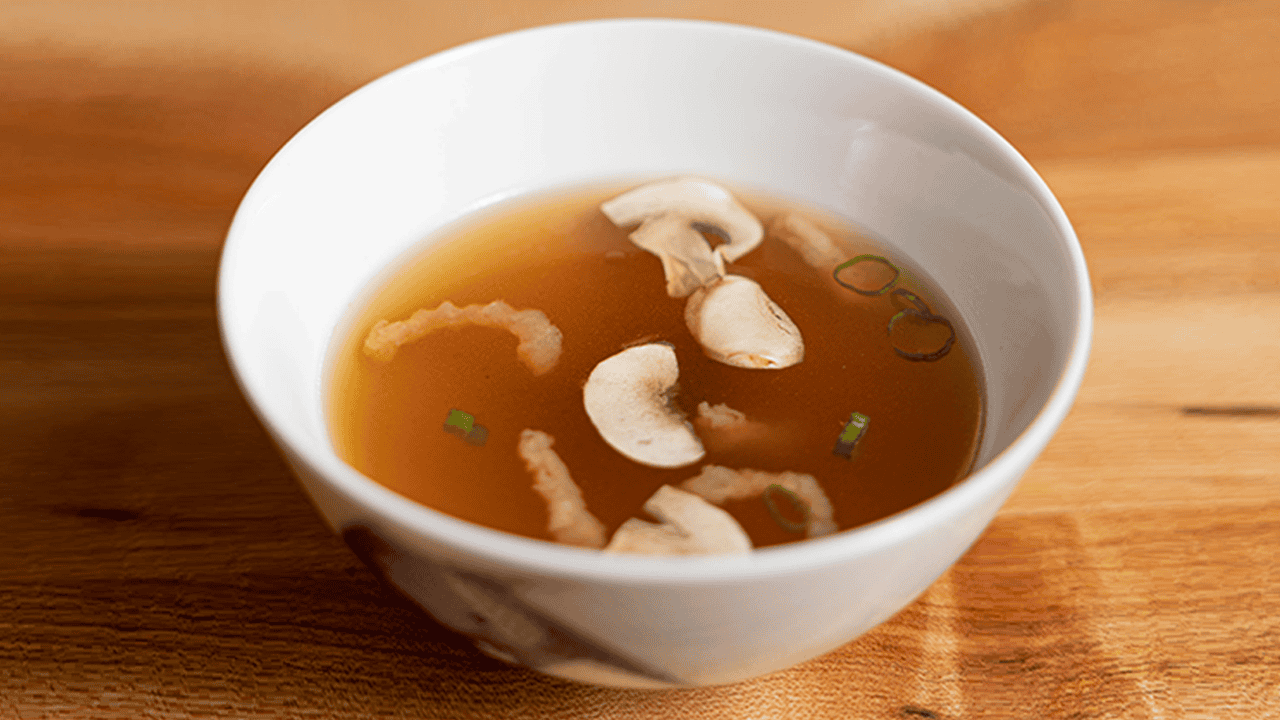
8. Serve. Place a pinch of fried onions at the bottom of a bowl. Add a few paper-thin mushroom slices and a pinch of thinly sliced green onions on top. Ladle the seasoned broth over the garnishes.
The Grocery Store Version
If you don't want to track down the HACO stock bases, you can make a version using ingredients from any grocery store that gets about 95% of the way to the restaurant flavor.
The swap is straightforward: replace the HACO chicken base with one can (10.5 oz) of Campbell's condensed chicken stock, and replace the HACO beef base with one can (10.5 oz) of Campbell's condensed beef consomme. Everything else in the recipe stays exactly the same.
The important detail is to use Campbell's condensed beef consomme specifically, not regular beef stock or broth. Since most of the liquid in this recipe is water and beef consomme, the broth comes out almost as clear as the HACO version. The condensed chicken stock is the only component that adds a little cloudiness, but the difference is minor.
In terms of flavor, the grocery store version has a slightly more pronounced beefy taste and is a bit more one-dimensional than the Benihana version, but most people won't notice the difference. It's significantly closer to what you get at a Japanese steakhouse than any other recipe that exists online.
Tips for the Best Hibachi Onion Soup
Slice your garnishes as thin as possible. The mushrooms and green onions should be paper-thin. The mushrooms aren't cooked, so they need to be thin enough to soften when the hot broth hits them. If they're too thick, you end up chewing through raw mushroom in what's supposed to be a delicate soup.
Don't rush the caramelization. The vegetables need to be nicely browned, not just softened. The caramelization is responsible for the roasted sweetness in the broth. If you pull them off the heat too early, the broth won't have that flavor.
Season at the end, not during cooking. The broth will taste bland right after straining, and that's normal. All the real seasoning happens after the soup is done. Add kosher salt ½ teaspoon at a time and taste between additions. You want a well-seasoned broth, and it usually takes 3 to 5 extra teaspoons beyond what goes in during simmering.
Don't press the vegetables when straining. It's tempting to push the softened vegetables against the strainer to get more liquid out, but this releases small particles into the broth and clouds it.
The soup tastes even better the next day. If you make the broth ahead of time, cool it down, and refrigerate it overnight, the broth tastes noticeably richer. Reheat gently on the stove and add your garnishes fresh when serving.
Storage and Reheating
The strained broth keeps in the refrigerator for 3 to 4 days in an airtight container. You can also freeze it for up to 3 months. Reheat gently on the stove over medium-low heat. Add the garnishes (mushrooms, green onions, fried onions) fresh when serving, not before storing. The fried onions dissolve if they sit in the broth too long.
Frequently Asked Questions
What is hibachi soup called?
The clear onion soup served at Japanese steakhouses like Benihana goes by several names. You might see it called hibachi soup, Japanese clear onion soup, Japanese onion soup, clear soup, or miyabi soup. They're all the same dish: a clear meat broth simmered with vegetables, strained, and served with mushroom and green onion garnishes.
Can I use regular beef broth instead of consomme?
You can, but the broth won't be as clear. Regular beef broth and stock are unclarified, meaning they contain proteins and particles that make the liquid cloudy. A consomme is a stock that's been clarified (typically with egg whites), which removes those particles and produces a transparent broth. If clarity matters to you, use Campbell's condensed beef consomme for the grocery store version. If you don't care about clarity, regular beef broth will work, but the soup will look quite different from the restaurant version.
Why is my homemade hibachi soup so bland?
Almost certainly a seasoning issue. The broth is supposed to taste bland right after you strain it. The most important step in this recipe is adjusting the salt at the very end. Add kosher salt ½ teaspoon at a time, tasting between additions, until the broth is well-seasoned. It usually takes 3 to 5 extra teaspoons of salt beyond what goes in during simmering.
What's the difference between hibachi soup and miso soup?
They're completely different soups. Hibachi soup (clear onion soup) is a meat-based broth made by simmering caramelized vegetables, then straining everything out to produce a clear liquid. Miso soup is made from dashi (a Japanese stock typically based on kombu and bonito flakes) with miso paste stirred in, usually served with tofu and seaweed. Both are served at Japanese restaurants, but they share almost nothing in terms of ingredients or technique.
More Soup Recipes
- Chinese Takeout Wonton Soup
- Chinese Takeout Hot and Sour Soup
- Chinese Takeout Egg Drop Soup
- Homemade Ramen from Scratch
- World-Class Beef Pho
More Benihana Recipes
- Benihana Fried Rice
- Benihana Garlic Butter
- Benihana Yakisoba
- Benihana Teriyaki Sauce
- Benihana Teriyaki Chicken
- Benihana Teriyaki Steak
- Benihana Spicy Teriyaki
- Hibachi Chicken
- Hibachi Steak
- Hibachi Shrimp
- Hibachi Vegetables
- Benihana Yum Yum Sauce
- Benihana Spicy Sauce
- Benihana Diablo Sauce
- Benihana Ginger Salad Dressing
- Benihana Mustard Dipping Sauce
- Benihana Ginger Dipping Sauce
- Banana Tempura
- Every Benihana Recipe (Complete Guide)
More Japanese Recipes
More Teriyaki Recipes
Recipe

Benihana Hibachi Onion Soup
Equipment
- 1 Large Pot Medium stockpot works
- 1 Fine Mesh Strainer For straining the broth
- 1 Whisk
- 1 Mixing Bowls For dissolving stock bases
- 1 Ladle
- 1 Deli Containers For storing prepped garnishes
Ingredients
The Broth
- 2 tablespoon vegetable oil
- 4 garlic cloves lightly crushed
- 1 ½ cups onion roughly chopped
- ¾ cup carrot roughly chopped
- ¾ cup celery roughly chopped
- ½ teaspoon HACO chicken flavor base paste Swiss Chalet brand, dissolved in 1 cup boiling water from the 8 cups total
- ½ teaspoon HACO beef flavor base paste Swiss Chalet brand, dissolved in 1 cup boiling water from the 8 cups total
- 8 cups water divided: 2 cups boiling for stock, 6 cups added later
- 2 teaspoon kosher salt for simmering; additional salt added to taste after straining
- ½ teaspoon whole black peppercorns
The Garnishes
- button mushrooms thinly sliced, cleaned with damp paper towel
- green onions thinly sliced
- French's fried onions to taste
Optional Grocery Store Version
- 1 can Campbell's Beef Consomme 10.5 oz
- 1 can Campbell's chicken broth 10.5 oz
Instructions
Prep the Stock
- Bring 2 cups of water to a boil. Add ½ teaspoon HACO chicken base and ½ teaspoon HACO beef base to a bowl. Pour the boiling water over the pastes and whisk until completely dissolved. Set aside.
Prep the Garnishes
- Wipe button mushrooms clean with a damp paper towel. Trim any long stems and slice as thinly as possible. You want them paper-thin so they almost dissolve in the hot broth.
- Thinly slice green onions. Store mushrooms and green onions in covered containers in the refrigerator until ready to serve.
Make the Soup
- Add 2 tablespoons soybean oil (vegetable oil) to a medium stockpot over medium heat until the oil is lightly shimmering. Add 4 lightly crushed whole garlic cloves and saute until garlic is browned. Remove garlic from pot and set aside. Do not let the garlic blacken or it will make the soup bitter.
- Add the chopped onion, carrot, and celery to the pot. Saute, stirring frequently, until the vegetables are nicely caramelized. The browning brings out sweeter, more complex flavors and gives the broth a roasted quality.
- Return the garlic to the pot. Add the reconstituted chicken and beef stock. Bring to a boil, reduce to a simmer, and simmer for approximately 3 minutes.
- Add 6 cups (1.4 liters) of water, 2 teaspoons (6 grams) of kosher salt, and ½ teaspoon (1.5 grams) of whole peppercorns. Bring to a boil, then reduce to a very light simmer for 45 minutes. Optionally skim the oil and fat from the surface while simmering.
- After 45 minutes, strain the soup through a fine mesh strainer, discarding the vegetables. Do not press the vegetables against the strainer as this can cloud the broth.
- Allow the broth to cool slightly, then taste. It will be fairly bland at this point. Adjust seasoning by adding kosher salt ½ teaspoon at a time until the broth is well-seasoned. Expect to add 3 to 5 extra teaspoons of salt.
Serve
- Place a pinch of French's fried onions at the bottom of a bowl. Add a few paper-thin mushroom slices and a pinch of thinly sliced green onions on top. Ladle the seasoned broth over the garnishes.
Video
Notes
Replace the HACO stock bases with 1 can (10.5 oz) Campbell's condensed beef consomme and 1 can (10.5 oz) Campbell's condensed chicken stock. Use the exact same method. The grocery store version is about 95% similar in flavor and nearly as clear as the Benihana version. The important detail is to use Campbell's condensed beef consomme specifically, not regular beef stock or broth. Why Is the Restaurant Version So Clear?
HACO brand stock bases are actually consomme bases. A consomme is a stock that's been clarified using a coagulating agent (typically egg whites), which removes particles and produces a nearly transparent liquid. Regular stock is unclarified, which is why home versions always look cloudier than what you get at the restaurant. Seasoning Is the Most Important Step
The broth will taste bland right after straining. All the seasoning happens at the end. Add kosher salt ½ teaspoon at a time, tasting between additions, until the broth is well-seasoned. Don't Simmer Longer Than an Hour
Peak extraction time for vegetables in a simmering liquid is 45 minutes to 1 hour. After that, vegetables start breaking down, which can add bitterness and release particles that cloud the broth. Storage
Strained broth keeps 3-4 days refrigerated in an airtight container, or up to 3 months frozen. Add garnishes fresh when reheating, not before storing. Fried onions dissolve if they sit in the broth too long.