Tex-Mex Cheese Enchiladas
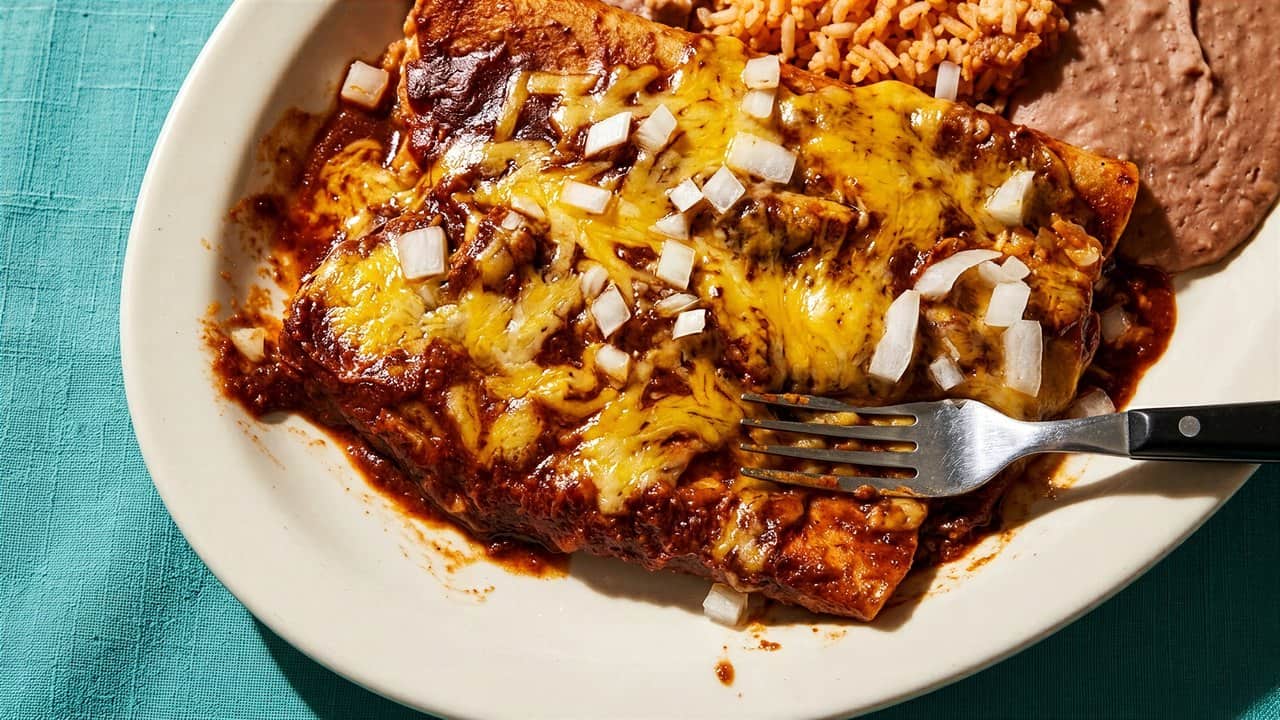
Texas cheese enchiladas the way the old Tex-Mex restaurants made them: corn tortillas softened in hot oil, filled with deli American cheese and a little mild cheddar, and baked under a real chili gravy made from flour cooked in lard, chili powder and Knorr Caldo de Pollo. My version is worked out from the old Texas restaurant cooks' own printed methods, with Mexican rice and refried beans fried in lard on the plate. It takes about 16 hours start to finish, but 12 of that is the overnight bean soak, and the rice, gravy and enchiladas all come together in about an hour.
Serves 6 servings
Calories 1620
Ingredients
The Chili Gravy
- 6 tablespoon lard or any neutral oil
- ½ cup all-purpose flour
- ¼ cup chili powder Gebhardt; or ¼ cup McCormick chili powder (it has salt, so taste before salting)
- 2 teaspoon ground cumin
- 2 teaspoon garlic powder
- 1 teaspoon Mexican oregano dried; regular dried oregano works if you can't find Mexican
- 1 teaspoon black pepper ground
- 4 cups hot water
- 4 teaspoon Knorr Caldo de Pollo chicken bouillon any powdered chicken bouillon works
- 1 teaspoon Morton table salt to taste, at the end: I use about 1 tsp
The Enchiladas
- 12 yellow corn tortillas 6-inch, a day or two old; yellow or white corn
- 1 cup vegetable oil for softening the tortillas; any neutral oil works
- 5 ¼ cups American cheese grated from a block from the deli counter (about 1 ½ lb); ask for it in block form
- 1 ¾ cups mild cheddar cheese grated from one 8 oz block; divided: ¾ cup inside, 1 cup for the top
- 1 medium white onion finely chopped (about 1 cup); divided: ¾ cup inside, ¼ cup on top
The Mexican Rice
- 2 cups riceland long-grain white rice not parboiled or converted rice
- ¼ cup vegetable oil divided: 1 tablespoon for the purée, 3 tablespoon for the rice
- 2 Roma tomatoes cored and quartered (about 8 oz)
- ½ small white onion roughly chopped
- 2 garlic cloves
- hot water enough to bring the fried purée up to the 3 ½-cup line
- 4 teaspoon Knorr Caldo de Tomate tomato and chicken bouillon
- 1 teaspoon Morton table salt
- ½ teaspoon ground cumin
The Refried Beans: The Soak
- 1 lb dried pinto beans the freshest-looking bag on the shelf; old beans can take an hour longer
- 6 cups cold water
- 1 tablespoon Morton table salt
The Refried Beans: The Pot Beans
- ½ medium white onion
- 3 garlic cloves smashed
- water to cover by 2 inches
- 1 teaspoon Morton table salt for the last 30 minutes
The Refried Beans: The Fry
- ½ cup lard
- 1-1 ½ cups saved bean cooking liquid
- Morton table salt to finish, to taste
Instructions
Soak the Beans (the night before)
- Buy the tortillas a day or two ahead and leave them in their bag on the counter. A day-old tortilla holds together in hot oil and gravy where a very fresh one tears.
- The night before, pick over the pinto beans for little stones and rinse them. Stir the 1 tablespoon salt into the 6 cups of cold water until it dissolves, add the beans, cover and leave them on the counter for 8 to 16 hours. Drain and rinse.
- The beans can be finished first and held warm. Start the rice about 1 hour before serving, make the gravy while the rice cooks, and bake the enchiladas while the rice rests, so everything lands on the plate hot at the same time.
Make the Refried Beans
- Put the soaked beans, onion and garlic in a heavy pot and cover with water by 2 inches. Bring to a boil over medium-high heat, then turn down to a gentle simmer with the lid tilted. Add hot water as needed to keep the beans covered, and cook until a bean mashes easily with no chalky center, 1 ½ to 3 hours.
- For the last 30 minutes, stir in the 1 teaspoon salt.
- Take out the onion. Scoop the beans into a blender with 1 cup of their cooking liquid and blend until smooth. Save the rest of the liquid.
- Melt the lard in a large, heavy skillet or wide pot over medium-high heat until it shimmers. Pour in the bean purée (it will spatter) and whisk it into the lard. Boil, whisking, for 3 to 4 minutes, until the lard is fully worked in and the beans bubble and pull away from the sides.
- Loosen the beans with the saved cooking liquid, a splash at a time, until creamy. Keep them a little looser than looks right; they thicken as they sit.
- Taste the beans, then stir in salt ¼ teaspoon at a time, tasting after each, until they taste fully seasoned, not just "not bland." Hold them covered over the lowest heat, and taste again right before serving.
Make the Mexican Rice
- Blend the tomatoes, onion and garlic until completely smooth. Heat 1 tablespoon of the oil in a small skillet over medium heat, add the purée and cook, stirring often, for 6 to 8 minutes, until most of the liquid has cooked off and it is thick like a paste and darkened a shade with a few browned spots. Stir constantly at the end so it doesn't scorch.
- Scrape the fried purée into a 4-cup measuring cup and add hot water up to the 3 ½-cup line. Stir in the Knorr Caldo de Tomate, salt and cumin until dissolved. It will taste saltier than soup; the rice takes it all in. Keep it hot.
- Heat the remaining 3 tablespoon oil in a wide, heavy pot or deep skillet with a tight lid over medium heat until it shimmers. Add the rice and stir often until most of the grains are golden and the rice smells nutty, 8 to 10 minutes. Turn the heat toward medium-low if the grains brown in spots.
- Pour in the hot tomato liquid all at once (it will sputter) and stir once to free any rice stuck to the bottom. Bring to a boil over medium-high heat.
- Cover tightly, turn the heat to low and cook for 20 minutes. Don't lift the lid or stir.
- Take the pot off the heat and let it rest, still covered, for 10 minutes. Fluff with a fork.
Make the Chili Gravy
- Stir the Knorr Caldo de Pollo into the 4 cups of hot water until it dissolves. Keep it hot.
- Melt the lard in a heavy saucepan or saucier over medium heat until it is liquid and hot. Whisk in all the flour and cook, whisking constantly, until the roux turns light brown and smells toasty, about 6 to 10 minutes. It takes longer than you'd think, so keep whisking. If you see any black specks in it, it's burned and you'll have to start over. It will look looser than a typical roux, because the dry spices go into it next.
- Turn the heat to low. Add the chili powder and whisk until there are no dry clumps and the roux turns dark red, then add the cumin, garlic powder and black pepper and whisk until fragrant, about 1 minute. Much of the flavor in chili powder dissolves in fat, not water, so this minute in the hot roux is where it comes out. Don't let it scorch.
- Rub the oregano between your palms over the pan to crush it in, whisk once, and straight away pour in a splash of the hot broth, whisking hard. It will seize up and turn thick and pasty. Keep adding the broth a little at a time, whisking after each pour, until it turns liquid, then whisk in the rest until no lumps are left.
- Bring it up to a very light simmer, then let it barely simmer for about 10 minutes, whisking now and then, until it has some body but is still clearly looser than ketchup: not watery, not thick. Dip a spoon in and draw a finger across the back; the line should stay clean (the French call this nappe). It keeps thickening as it sits and again in the oven, so stop before it looks thick enough, and add hot water a splash at a time if it gets too thick.
- Taste, and stir in salt a little at a time until it tastes fully seasoned; I use about 1 tsp. Hold it over the lowest heat with the lid on, whisking now and then so no skin forms.
Soften the Tortillas
- Heat the oven to 400°F (204°C). Toss the American cheese with ¾ cup of the cheddar for the filling.
- Heat the oil in a sauté pan, about ½ inch deep, over medium-high heat to 365 to 375°F (185 to 191°C). Test with the edge of a tortilla: it should sizzle the moment it touches the oil. Oil that is too cool soaks into the tortilla and makes it greasy.
- One at a time, lay each tortilla in the hot oil for about 5 to 6 seconds, just until soft and bendable, not crisp. Lift it out with a spatula (tongs tend to tear them) and let the extra oil drip back into the pan.
- Lay each tortilla on paper towels and pat it dry. Oil left on the tortillas ends up pooled in the baking dish.
Fill, Roll and Bake
- Spread ½ cup of the gravy over the bottom of a 9 by 13 inch baking dish.
- Dip each softened tortilla quickly through the warm gravy: seconds, not a soak.
- Spoon ½ cup of the cheese filling and 1 tablespoon of chopped onion down the middle of each tortilla, roll it up and lay it seam side down in the dish.
- Pour gravy over the enchiladas until every one is moistened all over and every edge of tortilla is covered, but not swimming in sauce. You may not need all of it. Then sprinkle the remaining cheddar over the top, about 1 cup: a light, scattered layer with the gravy still showing between, not a solid blanket.
- Bake uncovered for about 15 minutes, just until the cheese on top starts to bubble, and take it out right away. Let it stand 5 minutes, then scatter the remaining ¼ cup of raw onion over the top.
Serve
- Put 2 enchiladas on each plate, with the rice and refried beans beside them.
Video
Equipment
Notes
The one mistake to avoid: not enough gravy. Pour until every enchilada is moistened all over and every edge of tortilla is covered, but not swimming. Any edge left sticking out dries out and turns hard in the oven. You may not need all of the gravy.
Why lard in the gravy? The old Texas restaurant accounts cook the flour in lard: Albert Villareal, head cook at Casa Rio in San Antonio for 23 years, as the food writer Robb Walsh printed it, and an El Paso recipe from about 1905. Most restaurants today use vegetable oil, and any neutral oil works here. The lard matters more in the beans.
Which lard? The shelf tub (Armour, Morrell Snow Cap, La Preferida, often labeled "Manteca") is sold everywhere. I use RC Ranch, sold in a glass jar. Fresh lard from a meat counter or Mexican market, often rendered from the carnitas, is tan and tastes of pork.
The cheese. American cheese gives the smooth, even melt of a restaurant enchilada but carries little cheese flavor, so a little cheddar goes inside with it, and cheddar goes on top. Process American cheese is made from cheddar and similar cheeses melted with a melting salt, which is why it melts smooth instead of going grainy. Deli-counter American in a block is the closest thing to the restaurant loaf a home cook can buy. Any block labeled "pasteurized process American cheese" works; outside the US, look for one labeled processed cheese. Velveeta is not the same thing: it is sold as a "cheese product." Grate both cheeses from the block; bagged shredded cheese carries an anti-caking coating.
Gebhardt or McCormick? Gebhardt is the old Texas chili powder, which started in San Antonio, and its label lists no salt. Sylvia Casares of Sylvia's Enchilada Kitchen in Houston says "I rely a lot on McCormick," and that it makes a big difference in chili gravy. McCormick lists salt and is lighter, so the same ¼ cup holds 24 g of it against 34 g of Gebhardt; taste before you salt. To me, the everyday Tex-Mex place tastes closer to Gebhardt, and the more upscale places taste closer to McCormick.
Why the oregano goes in last, rubbed. Dried leaves blacken in hot fat faster than ground spices do, so the oregano goes in at the end and the broth follows straight away. Its flavor oil sits in tiny glands on the leaf's surface, and rubbing the leaves between your palms cracks them open. Mexican oregano is a different plant from the oregano on a pizza, a cousin of lemon verbena, more citrusy and grassy.
How thick the gravy should be. It coats a spoon but stays looser than ketchup. It thickens as it sits and again in the oven, so loosen it with hot water rather than add flour. At my second test cook, 15 minutes of simmering came out slightly too thick and about 10 was almost right.
Greasy or torn tortillas. Greasy enchiladas come from oil that is too cool (Diana Kennedy and Steve Sando, separately), and from oil left on the tortilla: the first time I made these without patting them dry, there was oil pooled in the dish. A very fresh tortilla falls apart in hot oil or sauce; a day-old one holds. If yours still tear, Diana Kennedy's fix is to spread about 2 tablespoons of gravy on each fried tortilla instead of dipping it, roll loosely, and pour the rest over at the end.
Bake hot and short. Cheddar heated hard or too long squeezes out its fat (Harold McGee, On Food and Cooking), so take the dish out as soon as the cheese on top starts to bubble.
Making them ahead. Sylvia Casares says sauced enchiladas can wait up to 30 minutes, covered and not refrigerated, before they go in the oven. Robb Walsh's recipe for old-fashioned San Antonio cheese enchiladas rolls and bakes them right on an ovenproof plate with the rice and beans beside them, at 450°F for about 10 minutes, and many restaurants still heat each plate in the oven or under a broiler, which is why the plate is so hot. With ovenproof plates, this works at home too.
The rice. Don't rinse it: rinsing washes the added vitamins off enriched American rice (Julia Child and Shirley Corriher). Don't use parboiled or converted rice; as Sylvia Casares says, it puffs up and won't take up the liquid. Use hot liquid, not cold, or the rice can turn mushy. The salt is fixed, 4 teaspoons of Caldo de Tomate and 1 teaspoon of table salt, with no broth or canned tomato adding more, because salty rice is the most repeated complaint under Mexican rice videos on YouTube.
The beans. The salted soak (Kenji López-Alt's, from The Food Lab) seasons the beans from within and helps the skins soften with the inside. The blended beans go into the hot lard last, Ford Fry's way, and boil with it until the lard is fully worked in, so they turn creamy instead of greasy. Taste at the end: the lard and the extra bean liquid dilute the salt, so beans that tasted right before frying can taste unseasoned on the plate.
Salt. Every salt here is Morton table salt, the one everyone can buy.
Storing it. Keep leftover enchiladas, rice, beans and chili gravy in the fridge for 3 to 4 days, or freeze them for 3 to 4 months (USDA leftovers guide). The beans and the gravy thicken in the fridge; loosen them with a splash of water when you reheat.
Made this? Tap a star at the top of this card to rate it.
Calories 1620kcal
Course Main Course
Cuisine Tex-Mex