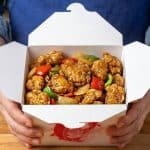
Sweet and Sour Chicken
Chinese takeout sweet and sour chicken with two sauces: the old-school red tossed in the wok with peppers and onion, the way takeout made it back in the day, or the clear neon red served on the side for dipping. The chicken is brined in baking soda and soy sauce, coated with dried egg powder the way Panda Express does its orange chicken, then fried, frozen and fried again so the crust stays crunchy under the sauce. It takes about 10 and a half hours from start to finish, most of it brining and freezing, with about an hour and a half of hands-on cooking in all.
Servings 4 servings
Calories 650kcal
Equipment
- 1 Made-In Carbon Steel Wok for frying
- 1 Made-In Saucier (2 quart) for the clear neon red
- 1 Cutting Board plastic
- 1 Whisk
- 1 Instant-read thermometer for the oil and the center of the chicken
- 2 Baking Sheet one under the rack, one for freezing
- 1 Wok Spider/Strainer for lifting the chicken out of the oil
- 1 Cuisinart Mesh Strainers (Set of 3) for skimming loose bits of batter out of the oil
- 1 Large Mixing Bowls metal; one sits over ice under the batter
- 1 Hefty Storage Gallon Bags for marinating and freezing
- 1 Colander
Ingredients
The Chicken and Brine
- 1 lb boneless skinless chicken breast cut into 1-inch pieces
- 2 cups water
- 1 teaspoon baking soda
- 2 tablespoon soy sauce regular, not low-sodium
The Marinade
- 1 tablespoon dried whole egg powder whole egg, not egg white powder or meringue powder
- ½ teaspoon Morton table salt
- ¼ teaspoon white pepper
- 1 tablespoon cornstarch
- 1 teaspoon vegetable oil
The Dry Dredge
- ⅓ cup cornstarch
- ⅓ cup potato starch or use all cornstarch
- ¼ teaspoon onion powder
- ¼ teaspoon garlic powder
- ⅛ teaspoon white pepper
The Wet Batter
- 1 cup all-purpose flour
- ⅔ cup cornstarch
- ½ cup potato starch
- 1 teaspoon onion powder
- 1 teaspoon garlic powder
- ¼ teaspoon white pepper
- ½ teaspoon baking powder
- ½ teaspoon Morton table salt
- 3 tablespoon dried whole egg powder
- 1 ⅓ cups ice water keep the batter ice cold
For Frying
- vegetable oil enough to deep fry
Old-School Red Sauce (one batch, for half the chicken)
- 6 tablespoon granulated sugar
- 4 ½ tablespoon distilled white vinegar
- 3 tablespoon pineapple juice canned, such as Dole
- 1 tablespoon water
- 2 tablespoon ketchup Heinz
- ¼ teaspoon Morton table salt
- ¼ teaspoon MSG
- 1 tablespoon cornstarch
Clear Neon Red Dipping Sauce (one batch, for half the chicken)
- 6 tablespoon granulated sugar
- 5 tablespoon water
- 4 tablespoon distilled white vinegar
- ½ teaspoon Morton table salt
- ⅛ teaspoon MSG
- 1 tablespoon cornstarch
- red food coloring liquid, a drop at a time; optional
The Wok (old-school red batch only)
- 1-2 teaspoon vegetable oil
- ¼ green bell pepper cut into 1-inch pieces
- ¼ red bell pepper cut into 1-inch pieces
- ¼ yellow onion cut into 1-inch pieces
- ¾ cup old-school red sauce from above
The Old Brown Sauce (optional, makes 1 cup)
- ¼ cup brown sugar packed
- ¼ cup distilled white vinegar
- ½ cup pineapple juice canned, such as Dole
- 1 ½ tablespoon soy sauce
- ½ teaspoon dark soy sauce
- 1 tablespoon cornstarch
- 2 tablespoon water cold
Instructions
Brine the Chicken
- Cut the chicken breast into 1-inch pieces, all about the same size so they fry in the same amount of time.
- Stir the water, baking soda and soy sauce together until the baking soda dissolves. Add the chicken, cover, and refrigerate for at least 2 hours and up to 24; the full 24 hours is even better.
- Drain the chicken without rinsing it. Pat it as dry as you can with paper towels, then spread it on a wire rack until no wet shine is left on the surface, because any water left on it keeps the coating from sticking.
Marinate
- Put the chicken in a large bowl with the egg powder, salt, white pepper, cornstarch and vegetable oil, and toss until every piece is evenly coated.
- Transfer it to a zip-top bag and massage the coating into the chicken through the bag. Seal it and refrigerate for at least 30 minutes; 2 to 4 hours is ideal.
Make the Dredge and Batter
- For the dry dredge, whisk the cornstarch, potato starch, onion powder, garlic powder and white pepper together in a large bowl.
- For the wet batter, whisk the flour, cornstarch, potato starch, onion powder, garlic powder, white pepper, baking powder and salt in a second large bowl. Add the egg powder and ice water and whisk until smooth, with no dry lumps left.
- Set the batter bowl over a bowl of ice so it stays between 35 and 41°F while you work. The bigger the gap between the cold batter and the hot oil, the more the batter puffs, and that leaves the little air pockets that make the crust crunchy.
First Fry (Set the Crust)
- Heat the frying oil in a wok or heavy pot to 350°F before you start dredging, since each piece goes straight from the batter into the oil. Set a wire rack over a baking sheet.
- Working a few pieces at a time, press the chicken firmly into the dry dredge and shake off the extra. Dip it in the cold batter, let the extra drip off, and lower it into the oil.
- Leave it alone for the first minute: this batter is light, almost like tempura, and comes apart if you stir it too soon. Then break up any pieces that stuck together. Fry in 2 to 3 batches so you don't crowd the wok and drop the oil temperature.
- Fry each batch 2 to 3 minutes, until the crust feels firm and pale gold and the bubbles streaming off it slow way down. The chicken is not cooked through yet; this fry only sets the crust.
- Drain on the wire rack, not paper towels, which trap steam and make the bottom soggy. Skim loose bits of batter out of the oil between batches so they don't burn and make the oil taste bitter.
Cool and Freeze
- Let the chicken cool on the rack, uncovered, to room temperature, about 30 minutes. Never hold the half-fried chicken in the fridge to finish another day.
- Spread the pieces in a single layer on a baking sheet and put them straight in the freezer, within 2 hours of frying. Freeze uncovered for at least 6 hours; overnight is best.
- Once it's frozen solid, move it to a zip-top freezer bag, press out as much air as you can and seal it. It keeps up to 2 months, and it's two dinners: each batch is half the chicken, about 15 oz (425 g).
Make the Sauce (one batch for each half of the chicken)
- For the old-school red, whisk the sugar, vinegar, pineapple juice, water, ketchup, salt, MSG and cornstarch in a bowl until no lumps remain. Set it aside for the wok.
- For the clear neon red, whisk the sugar, water, vinegar, salt, MSG and cornstarch in a small saucepan until no lumps remain. Add the red food coloring one drop at a time, whisking after each, until the color looks right to you.
- Set the saucepan over medium heat and keep whisking until it comes to a boil and turns glossy and thick, about 1 minute. Make it a little thinner than you think, because it thickens as it cools, then pour it into a small cup for dipping.
Second Fry
- Reheat the oil to 350°F. Shake the loose crumbs off half the frozen chicken, about 15 oz (425 g), and keep the other half in the freezer for another night.
- Fry it straight from the freezer, without thawing, until deep golden brown and the center of the thickest piece is at least 165°F, about 7 minutes. Don't thaw it first: the ice crystals on the crust steam off in the oil, and that's what makes it so crunchy.
- Drain the chicken on the wire rack again.
For the Neon Red: Serve With the Dip
- Serve the chicken plain, straight off the rack, with the cup of clear neon red on the side for dipping and no vegetables, the way takeout packs it.
For the Old-School Red: Toss in the Wok
- Heat a clean wok over high heat until it just starts to smoke. Turn off the heat, add the vegetable oil and swirl it to coat the wok, then turn the heat back on to medium-high.
- Add the green pepper, red pepper and onion and stir-fry 30 seconds to 1 minute, just until bright and glossy. Keep them a little crisp, because they still have to simmer in the sauce.
- Stir the old-school red well, since the cornstarch settles to the bottom, and pour it in. Keep stirring until it simmers and turns glossy and thick enough to cling to a spoon, about 1 minute.
- Add the fried chicken at the very last second and toss quickly until every piece is coated. Serve right away.
The Old Brown Sauce (Optional)
- In a small saucepan over medium heat, stir the brown sugar, vinegar, pineapple juice, soy sauce and dark soy sauce until the sugar dissolves and it comes to a simmer.
- Stir the cornstarch into the cold water, then stir it into the simmering sauce. Keep stirring until it turns clear, glossy and thick, about 1 minute.
- Use it in the wok steps in place of the old-school red, about ¾ cup for half the chicken.
Video
Notes
About the yield. The 1 lb of chicken goes through the brine, the marinade and the first fry all at once, then into the freezer. That makes two batches of about 15 oz each, and each batch serves 2. Fry one batch with one fresh batch of sauce, tossed in the wok for the old-school red or served on the side for dipping with the neon red, and keep the other frozen for another night. Each sauce takes about two minutes, so it's made fresh each time.
Why the chicken weighs more after frying. The 1 lb (453 g) of raw chicken weighs about 30 oz (850 g) once it has been through the marinade, the batter and the first fry, because the coating adds a lot of weight. So half the frozen chicken, the amount for one batch of sauce, is about 15 oz (425 g). Yours may be a little different depending on how much batter clings to each piece.
Why the brine and the marinade both. They do different jobs. The baking soda and soy brine works on the inside of the breast, keeping it tender and juicy through two fries. The full 24 hours is even better, so go the whole day if you can. The marinade works on the outside: the egg powder and cornstarch make a tacky layer that the dry starch grabs, so the batter stays on. Panda Express's Chef Jimmy Wang says the starch in its marinade is there to bind everything together and make it tacky (Bon Appétit, with Lucas Sin).
Why egg powder. A fresh egg adds water that has to cook off before the crust can crisp. Panda Express uses dried egg powder in its orange chicken marinade (Jimmy Wang). Make sure it says whole egg powder: egg white powder and meringue powder are easy to order by mistake and won't work the same. If your store doesn't carry it, order it online or look in a health food store.
Don't skip the freeze. Freezing pulls moisture out to the surface of the crust as ice. In the second fry it cooks off and leaves tiny air pockets behind, which makes the crust crisper. Panda Express fries its orange chicken once at the supplier, ships it frozen, and fries it again in the store (Jimmy Wang).
Food safety. The first fry leaves the middle of the chicken raw on purpose. Let it cool on a rack to room temperature, then put it straight in the freezer, within 2 hours of frying. Never hold the half-fried chicken in the fridge to finish another day. Finish it from frozen, or if you don't want to wait, bump the oil up to 375°F and do the second fry immediately. Either way, cook it until the thickest piece is at least 165°F in the center.
Why 350°F. Panda Express fries its frozen chicken a second time at 350°F for about 7 minutes, after shaking off the loose crumbs.
Why breast. Panda Express makes its sweet and sour chicken with breast: its own 2024 ingredient list names chicken breast bites. The same list includes baking soda and sodium phosphate (a salt that helps meat hold water), without saying where they go.
Swaps. No potato starch? Use all cornstarch in the dredge and the batter. Use distilled white vinegar: the bought sweet and sour sauces list distilled vinegar on their labels (Lee Kum Kee, La Choy, Panda Express's bottle), and rice vinegar or cider vinegar would change the flavor. Use regular soy sauce in the brine, not low-sodium. MSG is sold as Accent in almost any grocery store.
About the food coloring. It only changes the color, not the flavor. Leave it out if you prefer.
The old brown sauce. Before the sauce turned red, most of the oldest recipes printed in the United States, in the 1940s and 50s, were brown from soy sauce. This one is a blend of those printed sauces, not any one cook's recipe. No tomato, food coloring or MSG goes in.
Keeping it crisp. Drain on a rack, not paper towels, so steam can escape. The neon red served as a dip keeps the chicken crunchiest, since the sauce only touches each piece as you eat it. Keep the vegetables brief, since they let off water. For takeout-style leftovers, keep the sauce on the side and toss just before eating. A closed box or a lid traps steam and softens the crust.
Storage. The sauce keeps 3 to 4 days, covered, in the fridge. Sauced chicken keeps 3 to 4 days, covered, in the fridge; reheat it until it's steaming hot, 165°F. The once-fried chicken keeps up to 2 months in the freezer and goes into the second fry straight from frozen.
Made this? Tap a star at the top of this card to rate it.
Nutrition
Calories: 650kcal