Japanese Teriyaki Chicken
Japanese teriyaki chicken (tori no teriyaki) the way it's made in Japan: skin-on thighs started in a cold pan, then basted with a tare of soy sauce, sake, mirin and sugar until it reduces into a shiny glaze, with no cornstarch. It serves 2 and takes about 55 minutes, 20 of them letting the chicken come to room temperature.
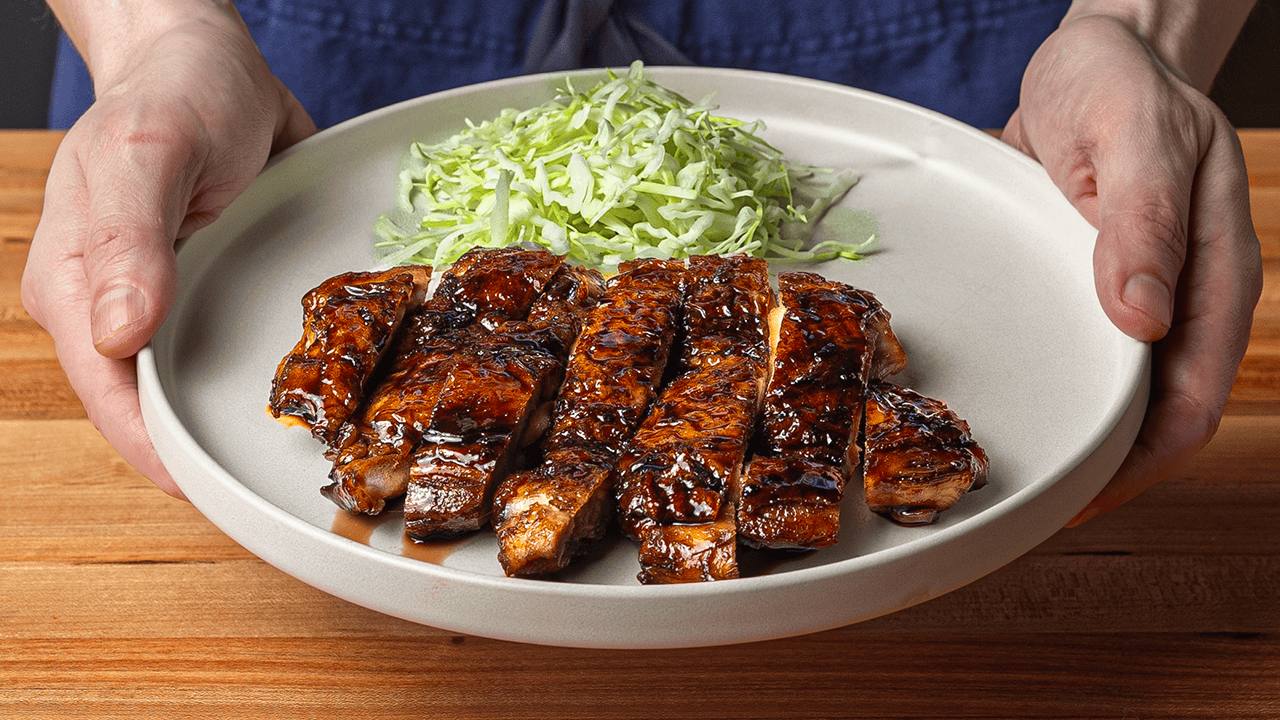
Serves 2 servings
Calories 520
Ingredients
The Tare (Golden Ratio)
- ¼ cup Japanese soy sauce Kikkoman, naturally brewed
- ¼ cup drinking sake Gekkeikan or Sho Chiku Bai (drinking sake, not the salted "cooking sake" / ryorishu)
- ¼ cup hon mirin Eden Foods Mirin, or a true hon-mirin like Hinode Junmai (avoid Kikkoman Aji-Mirin)
- 2 tablespoon white sugar
The Chicken
- 2 pieces bone-in skin-on chicken thighs about 1 lb total; boneless skin-on works too, see the post for taking the bone out
For Serving
- 2 cups Japanese short-grain rice cooked
- ¼ head green cabbage finely shredded, soaked in ice water 10 min, drained and patted dry
Instructions
Make the Tare
- Whisk soy sauce, sake, mirin, and sugar in a small bowl until the sugar dissolves. Set aside.
Prep the Chicken
- Place each thigh skin-down on a cutting board. Cut down the center to expose the bone. Cut along both sides of the bone, keeping the blade against the bone so you don't waste meat. Slide the knife under to free the bone. Save the bones for banno-dare.
- Trim any yellow fat and excess skin that hangs off the edges. Flip skin-side up and score the skin all over with the tip of the knife. The cuts let fat render and keep the skin from curling.
- Pat the thighs dry with paper towels on both sides. Let them sit at room temperature for 20 to 30 minutes before cooking.
The Skin Sear
- Place the thighs skin-down in a cold stainless or carbon steel skillet. Turn the heat to medium. For the first 1 to 2 minutes, press the chicken flat with a spatula to keep the skin in full contact with the pan.
- Cook skin-down for 7 to 8 minutes without moving the chicken. Periodically blot the rendered fat that pools in the pan with a folded paper towel. You're looking for kitsune-iro ("fox color"), a deep golden brown.
- Flip to the flesh side and cook another 4 to 6 minutes. The chicken should be about 80 percent cooked at this point. Remove to a plate, skin-side up.
The Fat Wipe
- Use a wad of paper towels to wipe out all rendered fat, browned bits, and residue from the pan. The surface should be clean and dry. A water-based tare in a greasy pan will slide off the chicken instead of adhering. This is the step most American recipes skip.
Make the Glaze (Teri)
- Return the pan to medium-high heat. Pour the tare into the center of the clean pan. It will bubble immediately as the soy sauce hits the hot metal.
- Place the thighs back in the pan with the skin facing up to keep it out of the sauce. Begin spooning the tare over the skin repeatedly.
- Watch the bubbles. Fine small bubbles mean the sauce is boiling but thin, so keep basting and don't rush. Bigger bubbles mean the sauce is thickening, so pick up the basting pace.
- When the bubbles reach 2 to 3 cm across, the sauce has real body. Keep basting until the tare visibly diminishes and coats the chicken like lacquer, then drop the heat to low.
- The chicken is finished when about 1 to 1.5 tablespoons of tare remain in the pan and the skin reflects the light like varnish. The full glazing phase takes 3 to 8 minutes. Before it comes out of the pan, the thickest part should read 165°F.
Rest and Serve
- Move the chicken to a cutting board and rest for 5 minutes. Slice each thigh on the bias into half-inch pieces. Spoon any remaining tare from the pan over the sliced chicken.
- Serve over short-grain rice with shredded cabbage soaked in ice water (drained and patted dry).
Video
Equipment
- 1 Made-In 12-inch Steel Frying Pan Stainless or carbon steel; do not use nonstick
- 1 Whisk
- 1 Misono Chef's Knife For deboning the thighs and slicing on the bias
- 1 Silicone Spatula For pressing the chicken flat in the cold-pan stage
- 1 Gray Kunz Chef's Spoon Large For basting the tare over the skin
Notes
The mirin matters most. Three things are sold as "mirin" in America. Real hon-mirin, like Hinode Junmai, is made from glutinous rice and rice koji fermented with shochu. Aji-mirin ("mirin-flavored") and mirin-fu ("mirin-style") are sweetened seasonings. Kikkoman Aji-Mirin's label starts with glucose syrup, water and alcohol, and Mizkan Honteri's with corn syrup. Eden Foods Mirin is a real mirin you can find at Whole Foods or on Amazon (it has a little sea salt, so it isn't strictly hon-mirin). With aji-mirin the sauce still cooks down, but the glaze won't have the same shine.
Sake. Use an inexpensive drinking sake like Gekkeikan or Sho Chiku Bai. Bottles labeled "cooking sake" (ryorishu) have salt added so they can be sold as a seasoning instead of as alcohol, and that salt ends up in the tare.
Wipe out the fat before the tare goes in. The tare is water-based, so any fat left in the pan keeps it from sticking to the chicken. Nearly every Japanese source does this.
No garlic or ginger. Traditional Japanese teriyaki tare has none; they came in with the Hawaiian and American versions. Add them if you like them, but the Japanese home version leaves them out.
White sugar. Brown sugar and honey both have flavors of their own; plain white sugar keeps the sweetness simple.
Doneness. The chicken finishes cooking in the tare. Before it comes out of the pan, the thickest part should read 165°F.
Save the bones for banno-dare. Char them under the broiler, then simmer them gently in a bigger batch of the same 2:2:2:1 tare for 45 minutes to an hour and a half, until it coats the back of a spoon, and strain. Use it over rice or noodles, as a marinade or as a glaze. Keep it in the fridge for 3 to 4 days (USDA), or freeze it in small portions for up to a couple of months, and bring it to a full boil before each use.
Storage. Cooked teriyaki chicken keeps 3 to 4 days in the fridge. Reheat it in a covered skillet with a splash of water over medium heat until it reaches 165°F. The microwave works but takes some of the shine off the glaze.
Made this? Tap a star at the top of this card to rate it.
Calories 520kcal
Course Main Course
Cuisine Japanese