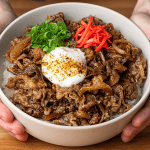
Gyudon (Japanese Beef Bowl)
Gyudon, the Japanese beef bowl, gets its flavor from two techniques most recipes skip: browning the onions at moderate heat and reducing the sauce uncovered. The beef is never seared. It goes into the simmering warishita raw, and the marbled fat renders into the sauce. This version uses real dashi steeped from kombu and katsuobushi, with hon-mirin and sake in the sauce and an onsen tamago on top made in nothing more than a pot of hot water. Developed from eighteen videos and about twelve thousand comments on why homemade gyudon tastes wrong.
Servings 4 servings
Calories 850kcal
Equipment
- 1 Made-In Saucier (5 quart) Browns the onions, reduces the sauce, steeps the dashi
- 1 Large Pot For the onsen egg water bath
- 1 Fine Mesh Strainer Straining the dashi
- 1 Microplane Grater Grating the ginger
- 1 Wok Spider/Strainer Lowering and lifting the eggs
- 1 Gray Kunz Chef's Spoon Large Spooning sauce over the beef
- 1 Whisk
- 1 Deli Containers Storing leftover dashi
Ingredients
The Rice
- 2 cups Japanese short-grain rice Rinse until the water runs clear. Cook at a 1:1.1 rice to water ratio or to your rice cooker's line.
- 1 piece kombu A 2-inch strip in the cooking water for background umami, removed before serving.
The Beef
- 1 lb well-marbled beef Sliced paper-thin against the grain. Thin-shaved ribeye or cheesesteak slices, or fatty short-plate (bara).
The Onion
- 1 large yellow onion Cut pole to pole into ¼-inch slices, not rings.
- 1 teaspoon vegetable oil Canola or any neutral oil.
The Dashi
- 4 cups water
- 1 piece kombu A 4-inch by 4-inch piece. Wipe with a damp cloth and leave the white powder on.
- 2 cups katsuobushi Packed. Makes 1 liter of dashi; this recipe uses ¾ cup.
The Sauce (Warishita)
- 2 tablespoon sake Drinking sake, not cooking sake.
- ¼ cup mirin Hon-mirin is best. Aji-mirin is the cheaper fallback.
- ¾ cup dashi From the batch above, or Hondashi granules stirred into hot water.
- ¼ cup soy sauce Regular Japanese soy sauce, not low-sodium.
- 1 ½ tablespoon granulated sugar
- 1 teaspoon fresh ginger Grated.
The Egg
- 4 eggs One per bowl. Use pasteurized in-shell eggs for a raw or onsen topping.
To Finish
- beni shoga
- scallions Thinly sliced.
- shichimi togarashi
- toasted sesame seeds
Instructions
Start the Rice
- Rinse the rice until the water runs clear, then cook it in a rice cooker or on the stovetop at a 1:1.1 rice to water ratio. Keep it hot. This runs in parallel with everything below. For background umami, add a 2-inch strip of kombu to the cooking water and pull it out before serving.
Slice the Beef
- If you bought pre-sliced hotpot, shabu-shabu, or sukiyaki beef, thaw it just enough to separate the sheets. Working from a block, freeze it 1 to 2 hours until firm but not solid, then slice as thin as you can against the grain.
Make the Onsen Egg
- Bring 7 ½ cups of water to a boil in a large pot, turn off the heat, and stir in 1 ½ cups of cold water. Lower in 3 to 4 eggs straight from the refrigerator, cover the pot, and wait 12 minutes. Move them to cold water right away so they stop cooking.
- Treat the first batch as a calibration run and pull one egg at 10 to 11 minutes to check, since pot, egg count, and water volume all shift the timing. Keep the 5 to 1 ratio of boiling to cold water when you scale, so two eggs get 5 cups boiling plus 1 cup cold. To use a raw egg at serving instead, skip this step and buy pasteurized in-shell eggs.
Make the Dashi
- Wipe the kombu with a damp cloth and leave the white powder in place. Drop it into 1 liter of cold water in the saucier over medium-low heat. The moment small bubbles start rising, just before it simmers, pull the kombu out. Do not let it boil.
- Turn off the heat and add the katsuobushi. Let it steep 2 minutes. Do not stir, which clouds the broth.
- Once the flakes have sunk, pour the dashi through a fine mesh strainer. Do not press the flakes, which turns the stock bitter, and do not let them sit past 4 minutes, which turns it fishy. This recipe uses ¾ cup. Cool the rest and refrigerate it covered for up to 3 days.
- For the shortcut version, stir Hondashi granules into hot water following the package.
Brown the Onions and Build the Sauce
- Set a wide, heavy pan or saucier over medium to medium-low heat. Add the oil and the onions, spread in a single layer. Cook, stirring every couple of minutes, until they soften and turn a deep, even golden brown, about 12 to 18 minutes. This is deeper than golden edges but short of full caramelization, and it drives the onion's water off before the sauce goes in.
- Pour in the sake and mirin. Simmer at moderate heat until the sharp alcohol smell is gone and the liquid reduces by about half, about 2 to 3 minutes. Reducing them alone strips more raw alcohol than adding everything at once, and the mirin sugars concentrate into a second gentle browning.
- Add the dashi and soy sauce, then the sugar and grated ginger. Stir until the sugar dissolves and bring it to a gentle simmer.
Simmer the Beef and Reduce
- Add the sliced beef, spreading the pieces so they separate in the liquid. Simmer gently just until the beef loses its pink, about 1 to 2 minutes. Do not sear it and do not over-simmer, because thin beef toughens and dries when it cooks too long. Skim off the foam and any oil that pools on the surface.
- Simmer uncovered and resist the urge to stir. Spoon the sauce over the beef every minute or so, which bastes the slices and keeps them from shredding. Let it reduce until the sauce coats the beef and onions and pools over the rice without flooding the bowl, about 4 to 6 minutes. Taste it before you call it done, since reducing concentrates salt.
Assemble
- Spoon hot rice into each bowl, then the beef, onions, and sauce over the top, adding extra sauce if you like a wetter bowl. Top each bowl with an egg, then finish with beni shoga, scallions, shichimi togarashi, and toasted sesame seeds.
Video
Notes
Simmered, Not Seared. This is the single most common mistake Western cooks make with gyudon. The beef is poached in the simmering sauce, never browned in a hot pan. Paper-thin beef seizes up and toughens when you sear it, and the marbled fat is the flavor engine. It renders into the sauce and makes the whole bowl taste beefier than a seared steak would.
Why Moderate Heat for the Onions, and Why "Caramelized" Is the Wrong Word. At stovetop temperatures, what you are getting on an onion is Maillard browning. True caramelization is pure sugar breaking down, and it needs much higher heat, around 330F, and a lot more time. The best onion browning happens around 300F. Medium to medium-low is the right setting, and 12 to 18 minutes is just how long it takes.
The Sauce, and How to Dial It. This is a traditional-leaning home version, not a chain copy. It runs 1 part soy to 1 part mirin, regular Japanese soy rather than low-sodium, a moderate amount of sugar, and 3 parts dashi to 1 part soy. Add more dashi for a brothier bowl, closer to 4 to 1. Use less for a thicker sauce, closer to 2.5 to 1. There is no single authentic ratio, so pick a point and know why. On names: the traditional home version is essentially a sukiyaki-style warishita, and the gyudon chains call their own commissary sauce a tare.
Sake and Mirin Are Not the Same Thing. Sake is dry and savory, and its job is to deodorize the beef and brighten the sauce. Mirin is the sweetener and the source of gloss. They are not interchangeable, and neither one is rice wine vinegar, which is a common and confident mistake. If you have to substitute the sake, dry white wine, dry sherry, or a splash of broth all work. Reducing them first strips most of the raw alcohol, though a small amount always remains.
Finding Paper-Thin Beef. You Already Have Access. Frozen hotpot, shabu-shabu, and sukiyaki beef come pre-sliced paper-thin. So do bulgogi at Korean groceries, milanesa at Mexican markets, shaved cheesesteak slices at most US supermarkets, and goulash meat at Central and Eastern European stores. Do not chase a precise thickness. The famous 1.3mm figure is a Yoshinoya factory slicer spec, not a home target.
Why the Kombu Comes Out Before It Boils. The flavor you want from kelp releases at low temperature. Boil it and you start pulling out alginic acid and fucoidan, which turn the stock bitter and a little slimy. The white powder on the surface is mannitol, a sugar alcohol the kelp produces as it dries. It looks like mold, it is not, and washing it off strips real flavor. Wipe the sheet, do not rinse it.
Why the Katsuobushi Steep Is Short. Thin-shaved katsuobushi, the fluffy kind sold in the US, gives up its flavor fast because of the surface area. Two minutes is the working number across Japanese sources, and the flakes sinking is the signal. Longer contact does not add flavor. It costs aroma and starts to turn the stock fishy. The 10 to 20 minute steeps in some recipes belong to thick shavings, which are hard to buy outside Japan.
The Egg Goes On Top, Never Cooked In. A raw or onsen egg on top is what makes it gyudon. Beat an egg and cook it into the beef and you have made tanindon, a different dish. For raw eggs in the US, use pasteurized in-shell eggs. The Yoshinoya standard is a whole raw egg (tamago), and a yolk only is the kimidake variation. An onsen egg works because the yolk sets at a lower temperature than the white, so gentle heat sets the yolk to a custard while the white stays barely set. If you own a sous vide, 63 to 64C (145 to 147F) for 40 to 45 minutes is the hands-off version.
Optional: The Yoshinoya White Wine Test. Yoshinoya uses no sake at all. Its commissary tare is based on a white-wine-based fermented seasoning, a deliberate choice by the company's second president to keep the bowl from getting tiring to eat every day. To test toward that flavor, replace the sake with an equal amount of dry white wine and reduce it alone exactly the same way. This is a test variable, not the base recipe.
Make-Ahead and Storage. The beef, onions, and sauce reheat well. Warm them gently so the beef does not toughen. Keep the rice separate and freshly cooked or reheated, make the eggs fresh at serving, and assemble bowls to order. Leftover dashi keeps 3 days covered in the refrigerator.
Allergens. Soy, egg, fish (dashi and katsuobushi), sesame, and wheat (in most soy sauce).
Nutrition
Calories: 850kcal