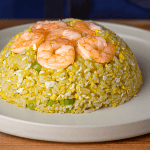
Din Tai Fung Shrimp Fried Rice
Din Tai Fung's shrimp fried rice uses only five core ingredients and no soy sauce. Built around Nishiki medium-grain rice, unbeaten eggs, and a dry "House Seasoning" blend of chicken bouillon powder, salt, and MSG. Fresh rice (not day-old) preserves the bouncy "Q" texture, and an alkaline baking soda wash gives the shrimp restaurant-level snap. Adapted for a standard home burner. Ready in about 5 minutes of actual cook time.
Servings 2 servings
Calories 400kcal
Equipment
- 1 Made-In Saucier (saucepan) for blanching shrimp
- 1 Anchor Glass Ramekins for House Seasoning
- 1 Kitchen Scale for rice-to-water ratio
- 1 Silicone Spatula for separating rice grains
- 1 Baking Sheet for cooling rice
Ingredients
The Protein
- 6-8 pieces raw shrimp peeled and deveined
- ¼ teaspoon baking soda for alkaline wash
- 1 tablespoon water for alkaline wash
- 1 pinch table salt for seasoning shrimp
The Base
- 1 ¼ cups cooked Nishiki medium-grain rice cooked at 1:1 to 1.1:1 water ratio
- 2 large eggs do not beat
- 2 tablespoon vegetable oil or any high-smoke-point neutral oil
- 2-3 stalks green onion white and light green parts only, finely chopped
House Seasoning (mix in a small bowl before cooking)
- 1 teaspoon chicken bouillon powder Lee Kum Kee red tin
- ¼ teaspoon MSG
- ¼ teaspoon table salt
Instructions
Prep the Shrimp
- Alkalize the shrimp. In a small bowl, combine the shrimp, baking soda, and 1 tablespoon of water. Toss to coat and massage for about a minute. Refrigerate for 15 minutes.
- Rinse the shrimp thoroughly under cold running water for 2 full minutes to remove any soapy taste from the baking soda. Pat dry with paper towels and season with a pinch of salt.
- Blanch the shrimp. Bring a small pot of water to a simmer and add the shrimp. Cook for about 1-2 minutes, just until they turn pink and are about 80-90% done. Remove and set aside.
Prep the rice
- Cook the rice using a 1:1 to 1.1:1 water-to-rice ratio. If your rice cooker has a "harder" setting, use it. Spread the freshly cooked rice on a baking sheet and fan it until it reaches room temperature, turning it a few times so moisture doesn't pool at the bottom. Do not refrigerate. You want fresh rice, not day-old.
Stir-Fry (5 Minutes)
- Heat a dry wok over medium-high heat until it just begins to smoke. Turn off the burner, add 2 tablespoons of oil, and swirl to coat the surface. This is the "long yao" (hot wok, cold oil) technique. It creates a temporary non-stick layer.
- Turn the heat back to medium. Immediately crack in the 2 eggs (unbeaten). Break the yolks with the back of your spatula and loosely scramble. You want ribbons of white and gold, not a uniform color. No browning. When the eggs are about 60-70% done and still runny, add the rice.
- Fold the rice into the eggs. Once roughly incorporated, switch to a smaller spatula and use a cutting motion to separate the grains. Keep the rice moving constantly and stay at medium to medium-low heat. No browning on the rice or the egg.
- Once the grains are separated and the rice looks glossy and golden, sprinkle the House Seasoning evenly over the rice. Stir-fry until fully incorporated and no dry seasoning is visible.
- Add the blanched shrimp and chopped scallions (white and light green parts). Toss until the shrimp are heated through and the scallions have wilted slightly. Remove from heat immediately. Do not add sesame oil.
Plating
- Place the shrimp at the bottom of a small bowl. Pack the fried rice tightly on top. Place your serving plate on top of the bowl, flip it over, and remove the bowl to reveal a dome shape.
Video
Notes
Rice choice: Din Tai Fung's Taiwan locations use Taikeng No. 9 short-grain rice. US locations use Nishiki medium-grain, which is what this recipe calls for. Jasmine or long-grain will work but won't give you the signature bouncy "Q" texture.
Fresh vs. day-old rice: This recipe intentionally uses fresh rice, not day-old. Refrigerating causes starch retrogradation, which hardens the outside but dries out the interior. Just cool it to room temperature on a baking sheet.
House Seasoning substitute: Din Tai Fung uses Knorr's Hong Kong formula chicken bouillon, which is unavailable in the US. Lee Kum Kee chicken powder in the red tin is the closest substitute. Do not use Western bouillon pastes like Better Than Bouillon.
Batch size: Always make 1-2 servings at a time. An overcrowded wok steams the rice instead of frying it. For more people, cook in small batches.
No soy sauce, no sesame oil: Both are intentionally excluded. Soy sauce adds moisture that causes clumping with medium-grain rice. Sesame oil would overpower the subtle flavors.
Nutrition
Calories: 400kcal