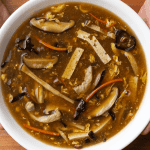
Chinese Takeout Hot and Sour Soup
This Chinese takeout hot and sour soup is reverse-engineered from 19 restaurant versions to nail the exact balance of spicy white pepper heat and tangy Chinese black vinegar. The key technique is adding the vinegar, white pepper, and sesame oil off the heat as a final seasoning to preserve their volatile aromatic compounds. Built on an Asian chicken bouillon base with dried shiitake mushrooms, wood ear fungus, and dried daylily buds for authentic takeout texture and flavor. Adapted for a standard home kitchen with step-by-step instructions.
Servings 6 servings
Calories 150kcal
Equipment
Ingredients
Pork Marinade
- 4 oz pork loin or chicken breast cut into ¼-inch slivers
- ⅛ teaspoon salt
- ⅛ teaspoon sugar
- ¼ teaspoon soy sauce Chinese light soy sauce
- ½ teaspoon Shaoxing cooking wine
- ¼ teaspoon cornstarch
- ½ teaspoon vegetable oil
Soup Broth
- 6 cups Asian chicken broth rom bouillon powder; replace some water with shiitake soaking liquid
- 2 teaspoon salt
- ½ teaspoon sugar
- 1 tablespoon soy sauce Chinese light soy sauce
- 1 teaspoon mushroom dark soy sauce Chinese mushroom-flavored dark soy sauce
Dried Ingredients (Rehydrated)
- 4-6 pieces dried black fungus rehydrated in boiling water 30-60 min
- 4-6 dried shiitake mushrooms rehydrated in boiling water 30-60 min; reserve soaking liquid
- 20 dried daylily buds rehydrated in cool water 20-30 min
Soup Additions
- 1 teaspoon ginger freshly grated
- ½ cup bamboo shoot strips blanched 30-60 seconds
- 4 oz firm tofu cut into ½-inch matchsticks
- ½ cup carrots julienned
Cornstarch Slurry
- 5 tablespoon cornstarch
- 5 tablespoon water
Egg Drop
- 1 large egg
- 1 teaspoon water loosens egg for finer threads
Final Seasoning (Added Off Heat)
- 3 tablespoon Chinese black vinegar Chinkiang/Zhenjiang; halve amount if using white vinegar
- 1 teaspoon white pepper
- 1 teaspoon toasted sesame oil
Instructions
Marinate the Protein
- Cut 4 ounces of pork loin or chicken breast into thin ¼-inch slivers. For chicken breast, cut across the grain for the most tender result. Add the salt, sugar, light soy sauce, Shaoxing cooking wine, cornstarch, and vegetable oil. Mix well and refrigerate for at least 20 minutes, or up to overnight.
Rehydrate the Dried Ingredients
- Wash the dried shiitake mushrooms under cold running water to remove any dirt. Place them in a bowl and pour boiling water over them. Soak for 30 to 60 minutes. Reserve the soaking liquid for the broth.
- Place the dried black fungus in a separate bowl and pour boiling water over them. Soak for 30 to 60 minutes. Discard the soaking liquid.
- Place the dried daylily buds in a bowl and cover with cool water. Soak for 20 to 30 minutes. Discard the soaking liquid.
- After soaking, lightly squeeze the shiitake mushrooms to remove excess water. Slice off the tough stems and discard them. Cut the caps into thin ⅛-inch strips.
- For the black fungus, find the small tough section where it was attached to the tree and slice it off. Roll each piece into a cigar shape and cut into ¼-inch slivers.
- For the daylilies, trim the tough ends from both sides and cut each one in half lengthwise.
Prepare the Protein and Bamboo Shoots
- Bring a large pot of lightly salted water to a simmer. Add the marinated pork or chicken and cook for 2 to 3 minutes until just cooked through. Remove with a spider strainer and set aside. Cooking the protein separately keeps the broth clean and clear.
- Add the bamboo shoots to the same simmering water and blanch for 30 to 60 seconds to remove any metallic, tinny flavor. Remove and set aside.
Prepare the Slurry and Egg
- In a small bowl, mix 5 tablespoons of cornstarch with 5 tablespoons of water and stir until completely smooth. Set aside.
- In a separate small bowl, beat 1 egg with 1 teaspoon of water until homogeneous. Set aside.
Prepare the Final Seasoning
- In a small bowl or measuring cup, combine 3 tablespoons of Chinese black vinegar, 1 teaspoon of ground white pepper, and 1 teaspoon of toasted sesame oil. Stir and set aside. These go in at the very end, off the heat.
Build the Soup
- Add 6 cups of prepared Asian chicken broth to a large pot. Replace some of the water with reserved shiitake mushroom soaking liquid for extra savoriness. Heat over medium heat until hot.
- Season the broth with 2 teaspoons of salt, ½ teaspoon of sugar, 1 tablespoon of Chinese light soy sauce, and 1 teaspoon of Chinese dark soy sauce. Stir until dissolved and taste for seasoning. The broth should taste well seasoned on its own.
- Whisk in 1 teaspoon of freshly grated ginger. Grating rather than dicing gives you the flavor without chunky pieces.
- Add the poached protein, shiitake mushrooms, black fungus, daylilies, julienned carrots, blanched bamboo shoots, and sliced firm tofu to the broth. Heat everything through for 3 to 5 minutes.
Thicken and Finish
- Slowly raise the heat until the broth reaches a gentle simmer. Stir the cornstarch slurry again (it will have settled) and slowly pour it into the broth while stirring constantly. Let the slurry thicken the broth for 1 to 2 minutes. It will seem thicker than you expect, but the vinegar will loosen it slightly later. Test by dipping a spoon in. The broth should coat the back of the spoon.
- Lower the heat to just below a simmer. Slowly drizzle in the beaten egg in as thin a stream as possible. Do not stir the soup while adding the egg. Let the egg set for about 1 minute in the thickened broth. The viscosity of the thickened broth acts as a raft, suspending the egg so it forms wispy ribbon strands. After the egg has set, gently stir to distribute it evenly.
- Turn off the heat and let the soup cool very slightly for about 30 seconds. Pour in the prepared vinegar, white pepper, and sesame oil mixture and stir it through the soup. Taste and adjust with extra vinegar or white pepper to your preference.
Video
Notes
Why add vinegar and white pepper at the end?
Vinegar, white pepper, and sesame oil all contain volatile aromatic compounds that break down with extended heat. Adding vinegar before the cornstarch slurry also raises the acidity of the broth, which reduces the thickening power of cornstarch because it can't properly gelatinize in an acidic solution. White pepper boiled in water loses its earthy spice and leaves behind bitter, musty notes. Treat all three as a final seasoning, not a cooking ingredient. Why poach the protein separately?
Cooking the meat directly in the broth means you have to skim scum and impurities off the surface, which can cloud the soup. Poaching the protein in a separate pot of salted water keeps your broth clean and clear. Pork vs. chicken.
Both work. Pork loin is more traditional in takeout versions. If using chicken breast, slice it across the grain into thin slivers for the most tender result. White vinegar substitution.
If you can't find Chinese black vinegar, regular white vinegar works. Use about half the amount since white vinegar is significantly more acidic. For a closer approximation, mix equal parts red wine vinegar and apple cider vinegar. Reheating tip.
This soup loses vinegar and white pepper punch as it sits. Always add a splash of extra vinegar and a pinch of white pepper to each serving when reheating. Ginger technique.
Grate the ginger on a Microplane rather than mincing it. You get the warm ginger flavor distributed evenly throughout the broth without biting into visible pieces. Firmer egg ribbons.
Beating about ¼ teaspoon of cornstarch into the egg with the water helps produce smoother, more defined ribbons. Shiitake soaking liquid.
Do not discard the liquid from soaking the shiitake mushrooms. Strain it through a fine mesh strainer and use it to replace some of the water when preparing the broth. It's concentrated umami.
Vinegar, white pepper, and sesame oil all contain volatile aromatic compounds that break down with extended heat. Adding vinegar before the cornstarch slurry also raises the acidity of the broth, which reduces the thickening power of cornstarch because it can't properly gelatinize in an acidic solution. White pepper boiled in water loses its earthy spice and leaves behind bitter, musty notes. Treat all three as a final seasoning, not a cooking ingredient. Why poach the protein separately?
Cooking the meat directly in the broth means you have to skim scum and impurities off the surface, which can cloud the soup. Poaching the protein in a separate pot of salted water keeps your broth clean and clear. Pork vs. chicken.
Both work. Pork loin is more traditional in takeout versions. If using chicken breast, slice it across the grain into thin slivers for the most tender result. White vinegar substitution.
If you can't find Chinese black vinegar, regular white vinegar works. Use about half the amount since white vinegar is significantly more acidic. For a closer approximation, mix equal parts red wine vinegar and apple cider vinegar. Reheating tip.
This soup loses vinegar and white pepper punch as it sits. Always add a splash of extra vinegar and a pinch of white pepper to each serving when reheating. Ginger technique.
Grate the ginger on a Microplane rather than mincing it. You get the warm ginger flavor distributed evenly throughout the broth without biting into visible pieces. Firmer egg ribbons.
Beating about ¼ teaspoon of cornstarch into the egg with the water helps produce smoother, more defined ribbons. Shiitake soaking liquid.
Do not discard the liquid from soaking the shiitake mushrooms. Strain it through a fine mesh strainer and use it to replace some of the water when preparing the broth. It's concentrated umami.
Nutrition
Calories: 150kcal