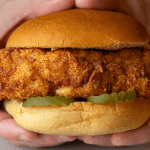
Chick-fil-A Chicken Sandwich
This reverse-engineered Chick-fil-A chicken sandwich recipe uses the exact spice blend confirmed by a former Chick-fil-A executive: black pepper, paprika, and mustard powder. After testing around 40 batches over two months, I dialed in a 6.7% salt brine with MSG and the confirmed spices, a seasoned coater with nonfat milk powder and granulated sugar, and the "seeding" technique for an extra crispy crust. Made with Walmart ingredients and a standard deep fryer or Dutch oven.
Servings 6 sandwiches
Calories 440kcal
Equipment
- 1 Dutch Oven Alternative to deep fryer
- 1 Deep Fry / Candy Thermometer Essential if using a pot
- 1 Meat Mallet For evening out filet thickness
- 1 Wire Cooling Rack For resting fried chicken
- 1 Jeweler's Gram Scale For precise salt measurement
- 1 100 Micron Coffee Filter For straining and reusing frying oil
- 1 Whisk For milk wash
- 1 Fine Mesh Strainer For sifting seasoned coater
Ingredients
Chicken Brine
- ¼ cup + 2 tsp Morton's kosher salt 67 grams. If using table salt: 3 tablespoon + 2 ¼ tsp. If using Diamond Brand: ½ cup. Or weigh 67 grams of any salt.
- ½ cup sugar
- 1 tablespoon MSG
- 2 teaspoon paprika
- ¼ teaspoon black pepper coarse ground
- 1 teaspoon mustard powder
- 1 liter water
Seasoned Coater (Double Batch)
- 2 cups + 2 tsp all-purpose flour
- 2 tablespoon sugar
- 1 ¾ teaspoon Morton's kosher salt If using table salt: 1 ½ tsp. If using Diamond Brand: 1 tbsp. Or weigh 9 grams of any salt.
- 2 teaspoon MSG
- 2 tbsp + 2 tsp nonfat milk powder
- 1 ½ teaspoon baking powder
- ½ teaspoon white pepper
- 2 teaspoon mustard powder
- 2 pinch cayenne pepper
- 4 tablespoon milk wash drizzle into flour mixture and crumble with your fingers to create "seeds" for extra crispy crust
Milk Wash
- 1 cup milk reconstituted from nonfat milk powder, or use skim milk
- 2 eggs
The Sandwich
- 2 boneless skinless chicken breasts 12-16 oz each; section into 4-oz filets (yields ~3 filets + 1 tenderloin per breast)
- 6 hamburger buns brioche preferred
- 2 tablespoon butter
- 12 dill pickle slices Vlasic Ovals Hamburger Dill Chips recommended; 2 per sandwich
- peanut oil for deep frying at 325°F; vegetable or canola oil also works
Instructions
Make the Brine
- Combine Morton's kosher salt, granulated sugar, MSG, paprika, black pepper, and mustard powder in a large bowl. Add 1 liter of water and stir until all the dry ingredients are completely dissolved. This is a 6.7% salt brine.
Prep and Brine the Chicken
- Remove the tenderloin from each breast and set aside. Trim the narrow end of the breast about halfway up, then butterfly the thick half and split it horizontally into two even pieces. You should get about 3 sandwich filets and 1 tenderloin per breast.
- Use a meat mallet to gently even out any thick spots. You want thin, uniform filets so they cook evenly and quickly.
- Place the filets in the brine, making sure they're fully submerged. Cover and refrigerate for 6 to 8 hours.
- Remove chicken from the brine and dry thoroughly with paper towels. The surface needs to be as dry as possible for the coating to stick.
Make the Seasoned Coater
- Combine all-purpose flour, granulated sugar, Morton's kosher salt, MSG, nonfat milk powder, baking powder, white pepper, mustard powder, and cayenne pepper in a large bowl. Sift the entire mixture through a fine mesh strainer to remove any clumps of flour or spice.
- Drizzle 4 tablespoons of milk wash into the flour mixture. Crumble it between your fingers until you get little beads of thickened coating throughout the flour. This is the "seeding" technique, and those beads fry up into the craggy, crunchy texture that the sandwich is known for.
Make the Milk Wash
- Reconstitute 1 cup of milk from nonfat milk powder following the directions on the box, or use 1 cup of skim milk. Whisk in 2 eggs until the mixture is completely smooth. Set aside and refrigerate if making in advance.
Bread and Fry the Chicken
- Heat peanut oil to 325°F (165°C) in a deep fryer or heavy-bottomed pot like a Dutch oven. If using a pot, clip a deep-fry thermometer to the side.
- While the oil heats, butter both halves of each hamburger bun and toast them in a pan over medium heat. Set aside.
- Dip each filet in the milk wash, shaking off the excess. Press it firmly into the seasoned coater with the palm of your hand. Chick-fil-A's training manual instructs employees to press so hard their heels leave the ground. Flatten the filet as evenly as possible, then shake off excess flour.
- Fry each filet for approximately 4 minutes and 20 seconds at 325°F. The breading should be deep golden brown and the internal temperature should read 165°F (74°C). Place finished filets on a wire rack set over a baking sheet. The air circulating underneath keeps the crust as crispy as possible.
Assemble the Sandwich
- Place 2 dill pickle slices on the bottom bun. According to Chick-fil-A's training manual, the pickles should be "dating, not mating" and should never overlap.
- Top with a fried chicken filet and crown with the top bun. Serve immediately.
Video
Notes
Salt Conversions: This recipe was developed with Morton's coarse Kosher salt. Different salts weigh differently by volume. One tablespoon of Morton's kosher salt weighs about 14.4 grams, while one tablespoon of table salt weighs about 18 grams. If you use the wrong type at the same volume measurement, you'll end up with too much or too little sodium. Each ingredient entry includes conversions for Morton's, Diamond Brand, and table salt. The safest approach is to weigh your salt: 67 grams for the brine, 9 grams for the double-batch seasoned coater.
Pickle Juice Myth: Chick-fil-A does not brine their chicken in pickle juice. This has been confirmed by hundreds of current and former employees. The chicken arrives at the restaurant frozen and pre-seasoned in a water, salt, MSG, sugar, and spice brine. The pickle flavor people associate with the sandwich comes from the actual pickle slices, not from the brine.
The "Spices" on the Label: According to the FDA's Code of Federal Regulations, the term "spices" on a food label specifically excludes substances traditionally regarded as foods, like onion, garlic, and celery. A former Chick-fil-A executive confirmed that the spice blend consists of black pepper, paprika, and mustard powder. This is the complete list.
Why Granulated Sugar, Not Powdered: Many recipes call for powdered sugar in the seasoned coater, but Chick-fil-A's official ingredient list does not include cornstarch. Powdered sugar is almost always blended with cornstarch, and they would be required to list it. Granulated sugar is the more likely choice and is also significantly cheaper at scale.
The Seeding Technique: Drizzling milk wash into the dry seasoned coater and crumbling it between your fingers creates small beads of thickened coating. These beads fry up into the craggy, textured crust that Chick-fil-A is known for. This is a standard technique in commercial fried chicken production.
Oil Reuse: Peanut oil can be reused 5 to 6 times if filtered properly after each use. Strain cooled oil through a 100-micron coffee filter or a cheesecloth-lined strainer. Store at room temperature in the original container. Discard when the oil darkens significantly or develops an off smell.
Freezer Storage: Brined chicken filets can be vacuum sealed and frozen for up to 3 months. This is essentially how Chick-fil-A stores their chicken before cooking. To use, thaw overnight in the refrigerator, pat dry with paper towels, and proceed with the breading step.
Nutrition
Calories: 440kcal