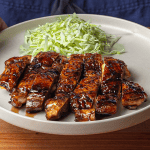
Authentic Japanese Teriyaki Chicken
Authentic Japanese teriyaki chicken (tori no teriyaki) made with the four-ingredient golden-ratio tare, the cold-pan skin-down sear, and the layered basting technique that produces the lacquered glaze. After three months of research through Japanese-language sources, this recipe brings the dish back to what "teriyaki" actually means: gloss-grilled. Includes the full hon-mirin buying guide so you don't end up with the corn-syrup aji-mirin product Kikkoman sells next to it on the shelf. Bone-in skin-on chicken thighs, a clean kitsune-iro skin sear, and the bubble stages that tell you when the tare has reduced into the teri.
Servings 2 servings
Calories 520kcal
Equipment
- 1 Made-In 12-inch Steel Frying Pan Stainless or carbon steel; do not use nonstick
- 1 Whisk
- 1 Misono Chef's Knife For deboning the thighs and slicing on the bias
- 1 Silicone Spatula For pressing the chicken flat in the cold-pan stage
- 1 Gray Kunz Chef's Spoon Large For basting the tare over the skin
Ingredients
The Tare (Golden Ratio)
- ¼ cup Japanese soy sauce Kikkoman, naturally brewed
- ¼ cup drinking sake Gekkeikan or Sho Chiku Bai (drinking sake, not the salted "cooking sake" / ryorishu)
- ¼ cup hon mirin Eden Foods or other hon-mirin (avoid Kikkoman Aji-Mirin)
- 2 tablespoon white sugar
The Chicken
- 2 pieces bone-in skin-on chicken thighs bone-in skin-on chicken thighs → about 1 lb / 450g total
For Serving
- 2 cups Japanese short-grain rice cooked
- ¼ head green cabbage green cabbage → finely shredded, soaked in ice water 10 min, drained and patted dry
Instructions
Make the Tare
- Whisk soy sauce, sake, mirin, and sugar in a small bowl until the sugar dissolves. Set aside.
Prep the Chicken
- Place each thigh skin-down on a cutting board. Cut down the center to expose the bone. Cut along both sides of the bone, keeping the blade against the bone so you don't waste meat. Slide the knife under to free the bone. Save the bones for banno-dare.
- Trim any yellow fat and excess skin that hangs off the edges. Flip skin-side up and score the skin all over with the tip of the knife. The cuts let fat render and keep the skin from curling.
- Pat the thighs dry with paper towels on both sides. Let them sit at room temperature for 20 to 30 minutes before cooking.
The Skin Sear
- Place the thighs skin-down in a cold stainless or carbon steel skillet. Turn the heat to medium. For the first 1 to 2 minutes, press the chicken flat with a spatula to keep the skin in full contact with the pan.
- Cook skin-down for 7 to 8 minutes without moving the chicken. Periodically blot the rendered fat that pools in the pan with a folded paper towel. You're looking for kitsune-iro ("fox color"), a deep golden brown.
- Flip to the flesh side and cook another 4 to 6 minutes. The chicken should be about 80 percent cooked at this point. Remove to a plate, skin-side up.
The Fat Wipe
- Use a wad of paper towels to wipe out all rendered fat, browned bits, and residue from the pan. The surface should be clean and dry. A water-based tare in a greasy pan will slide off the chicken instead of adhering. This is the step most American recipes skip.
Make the Glaze (Teri)
- Return the pan to medium-high heat. Pour the tare into the center of the clean pan. It will bubble immediately as the soy sauce hits the hot metal.
- Place the thighs back in the pan with the skin facing up to keep it out of the sauce. Begin spooning the tare over the skin repeatedly.
- Watch the bubbles. Fine small bubbles mean the sauce is boiling but thin, so keep basting and don't rush. Bigger bubbles mean the sauce is thickening, so pick up the basting pace.
- When the bubbles reach 2 to 3 cm across, the sauce has real body. Keep basting until the tare visibly diminishes and coats the chicken like lacquer, then drop the heat to low.
- The chicken is finished when about 1 to 1.5 tablespoons of tare remain in the pan and the skin reflects the light like varnish. The full glazing phase takes 3 to 8 minutes.
Rest and Serve
- Move the chicken to a cutting board and rest for 5 minutes. Slice each thigh on the bias into half-inch pieces. Spoon any remaining tare from the pan over the sliced chicken.
- Serve over short-grain rice with shredded cabbage soaked in ice water (drained and patted dry).
Video
Notes
The mirin is the most important ingredient call. Three things are sold as "mirin" in America. Real hon-mirin (Eden Foods, Hinode Junmai) is fermented from glutinous rice, rice koji, and shochu. Aji-mirin and mirin-fu chomiryo are corn syrup with rice flavoring. Aji-mirin won't reduce into the layered glaze the way hon-mirin will.
Sake. A cheap bottle of Gekkeikan or Sho Chiku Bai from the liquor aisle is what you want. The product labeled "cooking sake" (ryorishu) has added salt so it can be sold as a seasoning instead of as alcohol, which throws off the tare.
The fat wipe is non-negotiable. Skipping it means the tare slides off the chicken instead of lacquering the skin. Every Japanese source insists on it.
No garlic or ginger. Traditional Japanese teriyaki tare has no aromatics. Adding them is an American adaptation, not a baseline ingredient.
White sugar, not brown. Brown sugar's molasses and honey's distinct flavor both shift the tare away from its clean, neutral sweetness.
Save the bones for banno-dare. Roast the bones under the broiler, then simmer 45 minutes to 1.5 hours in a fresh batch of golden-ratio tare. Reduce until the sauce coats the back of a spoon, strain, and store in the fridge up to 2 weeks. All-purpose Japanese sauce for rice, noodles, marinades, or glazes.
Storage. Cooked teriyaki chicken keeps 3 to 4 days in the fridge. Reheat in a covered skillet with a splash of water over medium heat. The microwave works but dulls the lacquer on the skin.
Nutrition
Calories: 520kcal